
Understanding how the Social Security Administration (SSA) evaluates medical conditions is the first step toward…
9 Proven Reasons Why Representation at the Social Security Hearing Level Changes Outcomes
Why Representation at the Hearing Level Changes Outcomes
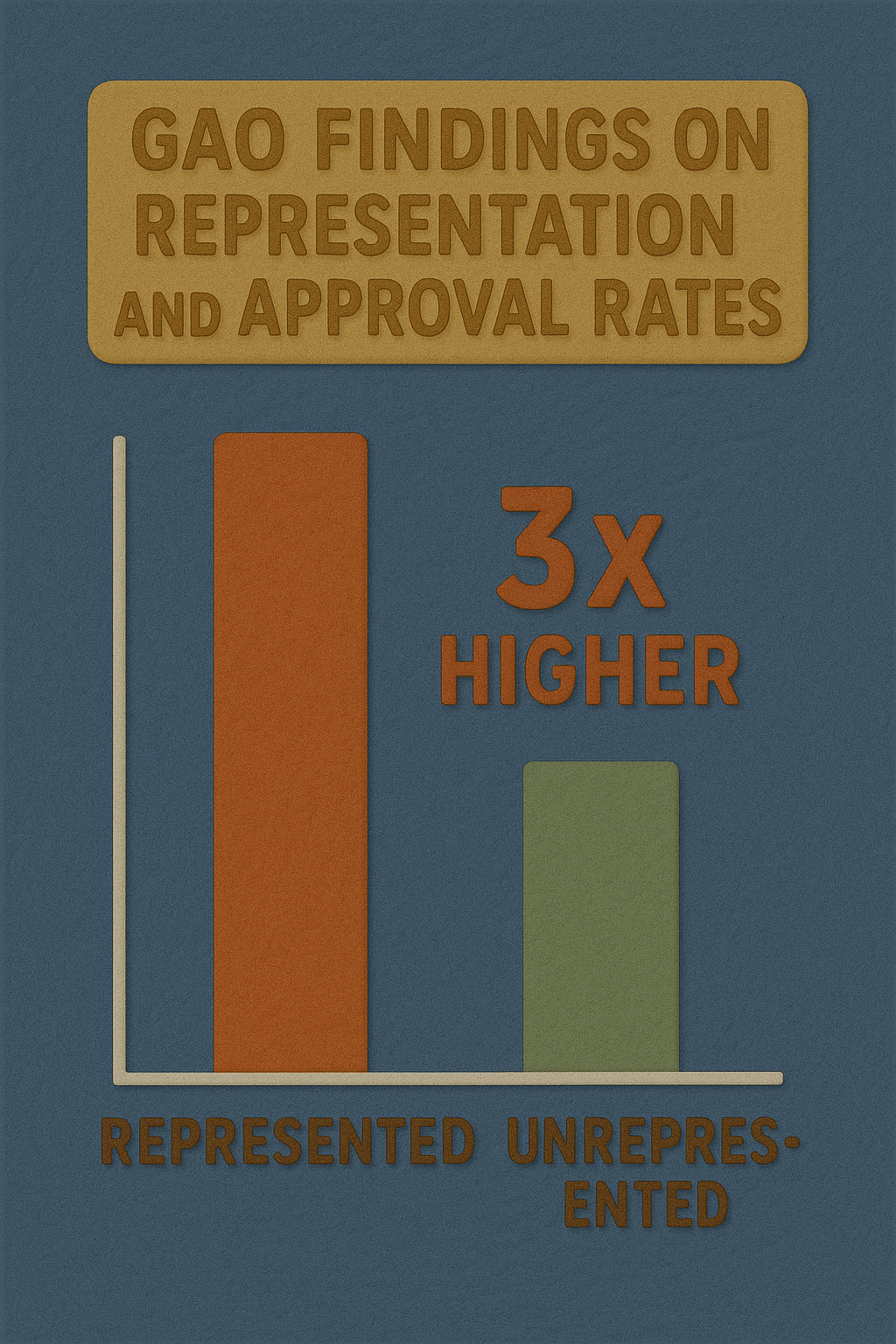
Representation at the Social Security hearing level can mean the difference between approval and denial. The data is clear: claimants who appear with qualified legal representation have dramatically higher success rates. According to the U.S. Government Accountability Office (GAO), represented claimants are almost three times more likely to receive a favorable decision than those without an attorney or advocate.
But what makes such a difference? At the hearing level, the rules are complex, evidence standards are strict, and Administrative Law Judges (ALJs) evaluate not just medical records but also testimony, credibility, and vocational evidence. Skilled representation ensures every piece of your case—from your medical file to your hearing testimony—is strategically aligned with Social Security’s regulations and standards of proof.
This detailed guide explains exactly why representation changes outcomes, drawing on GAO research, SSA policy, and Harbison & Kavanagh’s extensive experience helping clients across Virginia and nearby states. You’ll learn how attorneys use advocacy, preparation, and procedural precision to transform a claim into a compelling case for disability benefits.
Table of Contents
- Introduction
- Understanding the Hearing Level
- GAO Findings: Proof that Representation Works
- Why Representation at the Social Security Hearing Level Matters
- Pre-Hearing Preparation and Legal Briefs
- Medical Evidence: How Attorneys Strengthen the Record
- Expert Testimony: Cross-Examining VEs and MEs
- Advocacy Strategy: Turning Law into Persuasion
- Virginia and Regional Trends in SSA Hearings
- Watch and Listen: Expand Your Understanding
- Explore More Guidance
- Frequently Asked Questions
Introduction
When your Social Security Disability (SSD) or Supplemental Security Income (SSI) case reaches the hearing level, it’s often after years of waiting, denials, and frustration. The hearing represents your best chance for success—but also your last opportunity before a lengthy Appeals Council review. At this stage, procedural details and evidence presentation become crucial.
Unlike the initial and reconsideration phases, where state Disability Determination Services (DDS) examiners make decisions based solely on paperwork, the hearing is your moment to tell your story directly to an Administrative Law Judge (ALJ). But ALJs are not advocates. They are neutral decision-makers who rely on clear, credible, and legally structured arguments—the kind that an experienced disability attorney provides.
That’s why GAO studies and SSA data show the same pattern year after year: claimants with representation at the Social Security hearing level win far more often.
Understanding the Hearing Level
The hearing level is the third step in the SSA’s appeals process. After your initial application and reconsideration are denied, you can request a hearing before an ALJ. The judge reviews all evidence, hears your testimony, and may question vocational or medical experts before issuing a written decision.
At this stage, your representative can:
- Submit additional evidence to fill gaps in your record.
- Prepare a written brief that summarizes your case.
- Cross-examine experts whose testimony could hurt your case.
- Frame your story within SSA’s legal definitions of disability.
The hearing isn’t just about convincing the judge you’re unwell—it’s about proving you meet SSA’s legal criteria for disability, which requires matching medical and vocational factors to specific rules under 20 CFR §404.1505.

GAO Findings: Proof that Representation Works
The U.S. Government Accountability Office (GAO) conducted one of the most detailed studies of Social Security hearings to date. Their findings confirm what disability lawyers have long observed: representation directly improves results.
Key GAO Findings Include:
- Claimants with representation were nearly three times more likely to win their hearings.
- Represented claimants had fewer incomplete records and fewer procedural errors.
- ALJs reported that represented claimants’ cases were more organized and easier to evaluate.
- Medical and vocational evidence was significantly stronger in represented cases.
According to GAO’s analysis, this pattern holds across all demographics, conditions, and states. The difference is not luck—it’s advocacy. Representation ensures every element of the claim aligns with how judges interpret disability under SSA law.
In short: data proves that representation at the Social Security hearing level increases approval rates and reduces delays.
Why Representation at the Social Security Hearing Level Matters
Representation transforms a hearing from a conversation into a structured legal argument. Here’s how:
1. Navigating SSA Regulations
The SSA’s rules, known as the “Blue Book” and “POMS,” contain thousands of pages of medical, vocational, and procedural standards. Attorneys know which listings apply and how to interpret “functional equivalence” for conditions not explicitly listed.
2. Managing Procedural Deadlines
Missed deadlines can derail a case entirely. Representatives track every filing and ensure that evidence, briefs, and appeals are submitted before cutoff dates.
3. Presenting Evidence Effectively
Medical records alone aren’t enough. Attorneys summarize medical findings into legal arguments that satisfy SSA criteria—such as how pain, fatigue, or mental illness limit your ability to perform “substantial gainful activity.”
4. Crafting Persuasive Testimony
Claimants are often nervous or uncertain about what to say at hearings. Representatives prepare you for common ALJ questions and ensure your testimony aligns with medical evidence, avoiding contradictions that can weaken credibility.
5. Cross-Examining Experts
SSA hearings include vocational experts (VEs) and sometimes medical experts (MEs). Their testimony can heavily influence the ALJ’s decision. Representation ensures inaccurate or biased expert statements are challenged and corrected on record.
Pre-Hearing Preparation and Legal Briefs
Preparation begins weeks before the hearing date. Your attorney reviews every exhibit in your SSA file, ensuring all relevant documents are present and properly indexed. They then prepare a legal brief that outlines:
- Your medical and work history.
- Applicable SSA listings or vocational grid rules.
- Analysis of functional limitations and symptom severity.
- Summary of supporting physician opinions.
- Case law and SSA rulings that strengthen your argument.
This written brief becomes the judge’s first impression of your case—and often sets the tone for the hearing itself. Judges appreciate clarity and organization, and a concise, evidence-based brief saves them time and highlights the strengths of your claim.
Most importantly, your representative ensures the record is complete and chronological. Gaps in treatment history or missing records are proactively addressed before the hearing, preventing unnecessary continuances.

Medical Evidence: How Attorneys Strengthen the Record
SSA decisions hinge on evidence. Yet, many unrepresented claimants underestimate what counts as “medical evidence.” It’s not enough to submit test results or diagnosis letters. Evidence must demonstrate functional limitation—how your condition impacts daily life and work capacity.
Representatives build this connection through:
- Functional Capacity Evaluations (FCEs) performed by physical or occupational therapists.
- Residual Functional Capacity (RFC) questionnaires completed by treating physicians.
- Summaries of medication side effects and their vocational impact.
- Tracking frequency, duration, and severity of symptom flare-ups.
They also understand what *not* to submit—irrelevant, duplicative, or outdated records can clutter your file and distract from critical evidence. Organized, targeted documentation makes it easier for the judge to see your condition in context.
Expert Testimony: Cross-Examining VEs and MEs
Vocational Experts (VEs) testify about what jobs a person with your limitations could theoretically perform. Medical Experts (MEs) interpret your conditions and how they align with SSA listings. Without representation, many claimants find it impossible to challenge expert testimony—even when it’s inaccurate.
Representatives are trained to:
- Identify flaws in hypothetical job matches.
- Question VE assumptions about transferable skills or job numbers.
- Cross-check testimony against SSA’s Dictionary of Occupational Titles (DOT).
- Clarify inconsistencies between medical evidence and ME opinions.
Cross-examination requires not just confidence, but technical knowledge. Representatives understand SSA’s vocational framework and use it to reveal weaknesses in expert testimony. These subtle but powerful exchanges often determine the case outcome.
Advocacy Strategy: Turning Law into Persuasion
Every successful case has two parts: evidence and argument. Evidence shows the facts; argument connects those facts to SSA’s disability criteria. Representation ensures those connections are clear and persuasive.
Harbison & Kavanagh’s hearing advocacy focuses on:
- Applying the Five-Step Sequential Evaluation Process consistently.
- Using SSA’s vocational grids (Appendix 2) to demonstrate “no transferable skills.”
- Explaining how symptoms like chronic pain, fatigue, or anxiety affect attendance, focus, and productivity.
- Linking objective test results to specific RFC limitations.
- Ensuring the ALJ’s written decision has a solid legal basis for approval.
This advocacy transforms complex rules into accessible reasoning that judges respect. It’s not about emotion—it’s about legal clarity backed by evidence.
Virginia and Regional Trends in SSA Hearings
In Virginia and surrounding states, hearing offices (OHO) in Richmond, Roanoke, Norfolk, and D.C. satellite locations handle thousands of cases yearly. Regional trends affect strategy. For example:
- Richmond OHO: Judges often emphasize consistency in medical treatment and pain management documentation.
- Roanoke OHO: ALJs focus heavily on vocational adaptability—how limited education or transferable skills affect employability.
- Norfolk OHO: Mental health claims are common, requiring detailed functional assessments and psychiatric treatment notes.
- D.C. OHO: Judges expect thorough pre-hearing briefs and well-organized exhibits.
Understanding these patterns allows your representative to tailor evidence presentation to regional expectations—one of the key advantages of hiring a local Virginia disability attorney familiar with each office’s style.
Watch and Listen: Expand Your Understanding
Want to dive deeper into this topic while multitasking? Our upcoming podcast episode, “How Representation Changes Your SSD Hearing Outcome,” features Harbison & Kavanagh attorneys discussing GAO data, SSA policy changes, and real strategies for presenting winning cases.
Whether you’re commuting, preparing paperwork, or waiting for your hearing date, this conversation offers valuable insights on what to expect and how to prepare effectively for your day before the judge.
Explore More Guidance
Continue building your confidence before your hearing with our companion article, How to Prepare for Your SSD Hearing: Step-by-Step Attorney Advice. It includes practical guidance on evidence organization, demeanor, and communication—skills that complement the power of professional representation.
Frequently Asked Questions
Does representation guarantee a win?
No one can guarantee approval, but statistically, representation triples your likelihood of success and ensures every legal and medical angle is fully developed.
What if I can’t afford an attorney?
SSD attorneys are paid only if you win. Their fee—capped by federal law—is deducted from your back pay, not your future benefits.
Can an attorney attend the hearing for me?
You must attend, but your attorney will guide questioning, object when necessary, and handle expert cross-examinations to protect your rights.
What happens if I already had a hearing and lost?
You can appeal to the Appeals Council or file a new claim. Timelines are strict, so speak with a representative immediately.
How early should I hire a representative?
Ideally as soon as your initial application is denied. This allows enough time for record review, medical evidence development, and pre-hearing preparation.
Can representation help with mental health claims?
Yes. Attorneys are skilled in proving functional limitations in concentration, persistence, and social interaction—key factors in mental disability cases.
Does representation affect how judges view my case?
ALJs remain neutral, but organized, professional representation makes hearings smoother and evidence easier to assess, which often leads to faster decisions.
Will my representative speak for me during the hearing?
Your attorney introduces the case, asks clarifying questions, and delivers closing arguments—but you’ll still testify in your own words. The goal is teamwork.
Are non-attorney representatives effective?
Many non-attorney advocates are knowledgeable, but attorney representation ensures full legal authority for appeals, briefs, and federal court filings if needed.
Can my attorney submit new evidence after the hearing?
Yes, if allowed by the ALJ. Post-hearing briefs and supplemental evidence can be filed within specific timeframes.
At Harbison & Kavanagh, we are dedicated to helping you navigate the SSDI application and appeals process. If you believe you qualify for SSDI and have questions, call us today at (804) 888-8000, or visit our contact page to schedule a free consultation. Our experienced lawyers are here to provide the support and guidance you need.
Related Posts