
Key Takeaways: Your 2026 SSD Application Quick-Start Guide High Denial Risk: Approximately 65% of initial…
ALJ Approval Data in SSD/SSI Appeals: 7 Eye-Opening Insights for Your Social Security Disability Case
Do Judges Really Differ? What “ALJ Approval Data” Means for Your Case (and What We Do About It)
ALJ approval data in SSD/SSI appeals has sparked countless conversations among Social Security claimants and attorneys. People hear that some Administrative Law Judges (ALJs) are “lenient,” others are “strict,” and that luck of the draw could determine whether you win or lose. But is that true? How much does your judge really matter—and how much is in your control? The importance of ALJ approval data in SSD/SSI appeals cannot be overstated.
At Harbison & Kavanagh, we believe knowledge beats luck every time. We’ve studied years of ALJ data, represented clients before hundreds of judges across Virginia and nearby states, and seen firsthand what really moves the needle in a disability hearing. This blog breaks down what the numbers mean, what they don’t, and how strategic preparation—not “judge shopping”—turns data into success.
Table of Contents
-
- Introduction
- What Is ALJ Approval Data?
- How the SSA Gathers and Uses ALJ Data
- Why Judges Differ: Understanding Approval Variability
- Inside the Hearing Room: What Really Happens
- How Claimant Behavior Shapes ALJ Perception
- Why Preparation Beats “Judge Shopping” Every Time
- How We Apply ALJ Data to Strengthen Your Case
- Regional Trends Across Virginia and Neighboring States
- Visual: Regional ALJ Approval Patterns
- Five Strategies That Turn Data into Wins
- Visual: SSD/SSI Appeal Flow and Decision Points
- Visual: Judge Variability vs. Preparation Impact
- Watch and Listen: Expand Your Understanding
- Explore More: Strengthen Your SSD Appeal
- Frequently Asked Questions
- Ready to Take the Next Step?
Introduction
The analysis of ALJ approval data in SSD/SSI appeals reveals key insights into the decision-making processes of judges. Our understanding of this data enhances our strategies. When your disability claim reaches the hearing level, your fate lies with an Administrative Law Judge. That judge reviews your records, listens to your testimony, questions vocational experts, and issues a decision that can permanently affect your financial future. It’s no wonder claimants pay close attention to ALJ approval data in SSD/SSI appeals.
The Social Security Administration (SSA) releases data on how every ALJ decides cases—approvals, denials, and dismissals. And yes, the numbers vary widely. But numbers alone can’t tell the story of why some judges approve more often than others—or how to prepare to win before any of them. Understanding ALJ approval data in SSD/SSI appeals is essential for effective preparation.
That’s the key: preparation beats prediction. At Harbison & Kavanagh, we don’t rely on luck. We build your case with precision, evidence, and local insight that align with real ALJ patterns and expectations.
What Is ALJ Approval Data?
The SSA’s ALJ Disposition Data is a publicly available record of every judge’s decisions. It shows how many hearings they’ve held, how many cases they approved, denied, or dismissed, and how long they take on average to issue decisions. This information gives transparency into the process—but without context, it can be misleading.
For example, a judge with a 65% approval rate might seem “better” than one with 40%. But those statistics reflect the types of cases each office receives, the complexity of local claimants, and the presence (or absence) of skilled representation. It’s not about the judge—it’s about the details.
What matters most is how well your evidence, testimony, and representation align with what judges look for. That’s where using ALJ approval data as a preparation tool becomes invaluable.
How the SSA Gathers and Uses ALJ Data
The SSA compiles data from every hearing office nationwide. For each ALJ, it calculates the number of cases decided, approval percentages, and the share of dismissals. These numbers are used internally to evaluate consistency, detect bias, and identify outliers. But they’re also a goldmine of insight for claimants who understand how to interpret them.
For instance, an ALJ who denies more cases may preside in a region with higher volumes of incomplete applications. Another may have specialized in certain conditions—like mental health or musculoskeletal disorders—and appear more favorable to claimants with those issues. A skilled attorney can spot these nuances and tailor strategy accordingly.
At Harbison & Kavanagh, we regularly review new data releases to understand evolving trends across Virginia and nearby states. We know which judges emphasize medical documentation, which rely heavily on vocational experts, and which weigh credibility most. This isn’t about gaming the system—it’s about anticipating expectations so our clients walk into their hearings fully prepared.
Why Judges Differ: Understanding Approval Variability
Every ALJ is human. They interpret evidence through personal experience, training, and professional philosophy. But not every difference is bias—often it’s a matter of style. The SSA’s thousands of judges are trained under the same regulations, but they have discretion in how they evaluate “substantial evidence.”
Common reasons for differing approval rates include:
- Regional case types: Rural areas may see more physical labor injuries, while cities see more mental health claims.
- Caseload pressure: Judges handling 1,000+ cases a year may approve fewer borderline cases to manage time.
- Experience level: Newer ALJs tend to rule conservatively until they gain confidence and precedent.
- Claimant representation: Offices with high-quality legal advocacy show higher average approval rates.
These factors create patterns—not destiny. Skilled legal teams can turn these variables into advantages by anticipating and adapting to the judge’s tendencies.
Inside the Hearing Room: What Really Happens
Many claimants imagine an ALJ hearing as a courtroom showdown. In reality, it’s an administrative proceeding—private, conversational, and focused on details. You, your lawyer, the ALJ, and possibly a vocational or medical expert will attend. Most hearings last about 45 minutes.
The judge begins by summarizing your file and clarifying your medical history. Then comes testimony: the ALJ may ask how long you can stand, how often you see your doctor, or how your pain affects daily life. Your attorney will then question you to reinforce key evidence and may challenge any testimony from the vocational expert that suggests you can work.
This is where preparation shines. We rehearse testimony so you can respond calmly, truthfully, and confidently. We ensure the judge hears your limitations not as complaints, but as credible facts supported by records. When your hearing ends, the judge has a clear picture: not just of your condition, but of your consistency, honesty, and preparedness.
How Claimant Behavior Shapes ALJ Perception
It’s not just evidence that matters—how you present yourself affects the ALJ’s impression. Judges listen for consistency between your words, your medical records, and your daily activities. Small discrepancies—like saying you can’t lift five pounds but reporting that you grocery shop—can raise red flags.
We coach clients to stay authentic. It’s okay to have good days and bad days, but you must describe your “average day,” not your best one. We also advise dressing comfortably but respectfully, arriving early, and addressing the judge directly. These small steps communicate reliability and seriousness, helping you build trust from the moment the hearing begins.
In our experience, claimant demeanor can influence outcomes as much as documentation. Judges appreciate preparation, honesty, and effort. When they see a claimant who’s informed and represented, they take the case seriously—and that’s where we excel.
Why Preparation Beats “Judge Shopping” Every Time
Many claimants hope to get a certain “easy” judge. But that’s not how the system works. Hearings are assigned randomly. Trying to “wait” for a different judge only delays benefits and adds stress. Instead, we focus on what we can control—how your case is built.
Preparation transforms outcomes. We spend hours reviewing your file, identifying gaps, clarifying inconsistencies, and crafting pre-hearing briefs that speak directly to your ALJ’s reasoning patterns. Our experience with hundreds of hearings gives us the insight to predict what matters most in each courtroom.
That’s why our success rate isn’t tied to who’s on the bench—it’s tied to how well we prepare you for whoever is.
How We Apply ALJ Data to Strengthen Your Case
ALJ approval data in SSD/SSI appeals isn’t just numbers—it’s strategy. Here’s how we use it:
Utilizing ALJ approval data in SSD/SSI appeals effectively allows us to tailor our approach to fit specific judges and cases.
-
- Pattern Analysis: We study your judge’s history to identify focus areas, such as work capacity or medical opinion weight.
- Custom Evidence Packaging: We order medical records, RFCs, and witness statements to match how your ALJ prioritizes evidence.
- Pre-Hearing Strategy Meetings: We brief clients on likely questions based on data from past hearings.
- Vocational Expert Tactics: We prepare counter-questions for experts to ensure your limitations are fully recognized.
- Post-Hearing Advocacy: If the ALJ denies your claim, we analyze the decision data to prepare precise Appeals Council arguments.
By analyzing the ALJ approval data in SSD/SSI appeals, we develop a comprehensive strategy that addresses common challenges faced by claimants.
In short, we don’t fight blind—we fight informed.
Regional Trends Across Virginia and Neighboring States
Trends in ALJ approval data in SSD/SSI appeals can change, which is why continuous monitoring is critical for a successful outcome.
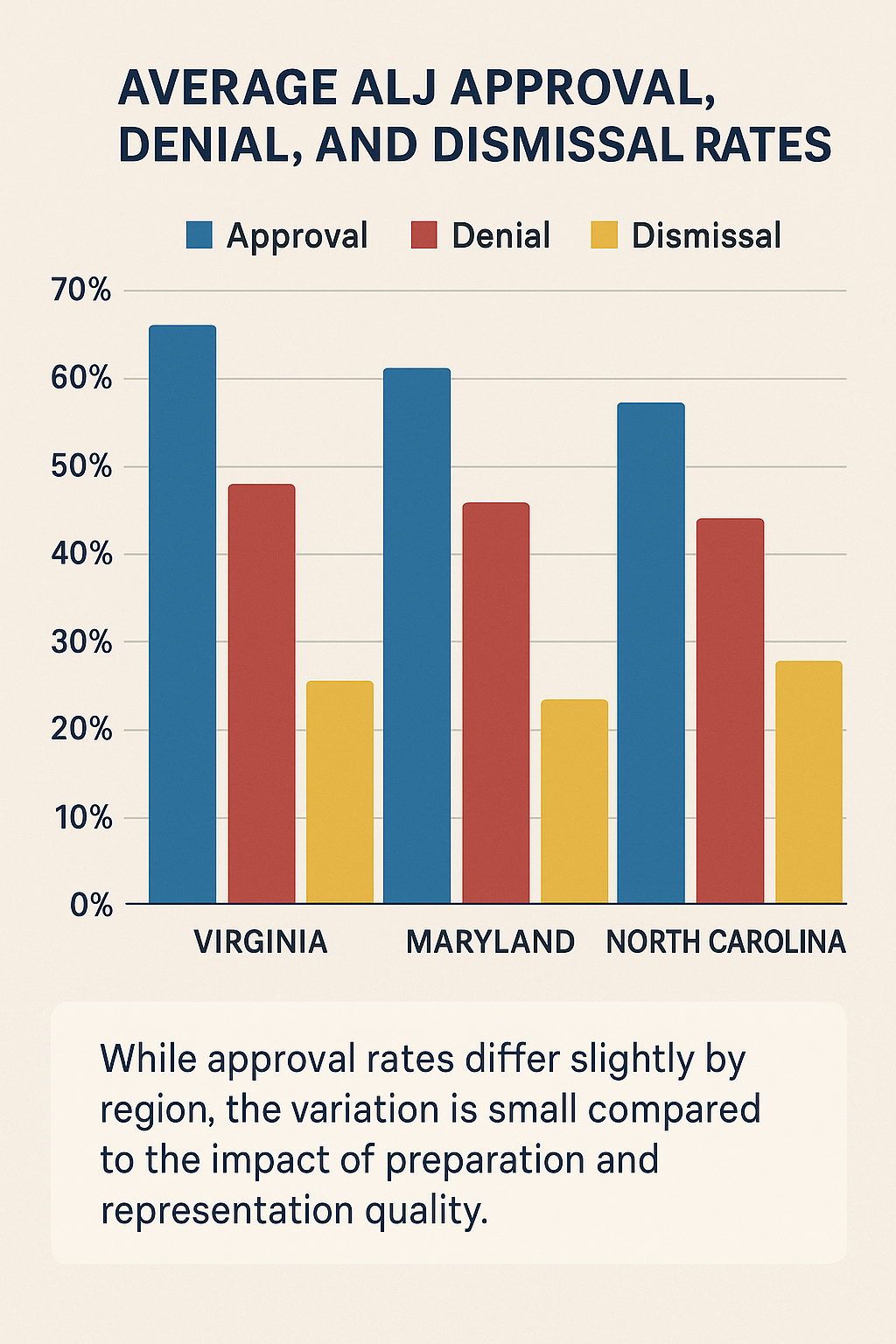
Data from recent SSA reports shows ALJ approval rates averaging 43%–55% across Virginia, Maryland, North Carolina, and Tennessee. Virginia judges emphasize thorough documentation and claimant credibility. Maryland and North Carolina often weigh vocational data more heavily. Tennessee’s ALJs tend to be more favorable toward older claimants and those meeting “Grid Rule” criteria.
These differences matter. For example, in a case involving degenerative disc disease, we may emphasize imaging results in Richmond but focus on functional testimony in Raleigh. The goal is always the same: present your evidence in the most persuasive way possible for your region and judge.
We leverage ALJ approval data in SSD/SSI appeals to ensure our clients are well-prepared for any line of questioning.
Visual: Regional ALJ Approval Patterns
Five Strategies That Turn Data into Wins
- Tell a Consistent Story: Consistency across medical records, statements, and testimony builds credibility—your strongest ally. This is crucial when aligning with ALJ approval data in SSD/SSI appeals.
- Anticipate Questions: We predict what your judge will ask and practice clear, confident answers that match your file.
- Document Function, Not Just Diagnosis: SSA judges rule on limitations, not labels. We make sure your evidence shows how symptoms limit daily function.
- Prepare for Vocational Challenges: Many hearings hinge on what “other jobs” you could do. We train you to discuss real-world limitations persuasively.
- Understanding ALJ approval data in SSD/SSI appeals helps us align our presentation to what judges expect.
- Use ALJ Data as a Roadmap: We tailor our briefs and presentation style to reflect your judge’s known reasoning and decision habits.
Visual: SSD/SSI Appeal Flow and Decision Points

Summary: The hearing and Appeals Council stages are where preparation and attorney advocacy have the greatest impact on outcomes.
Visual: Judge Variability vs. Preparation Impact
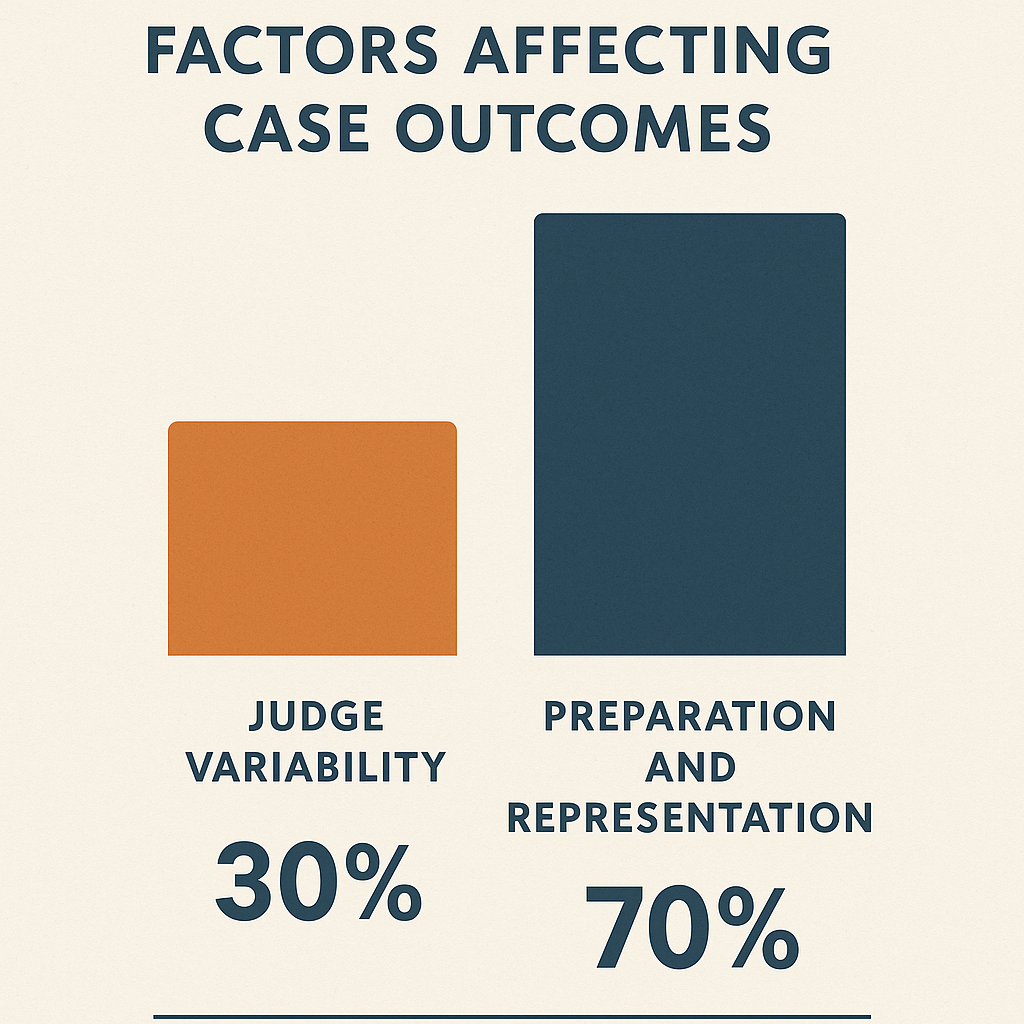
Summary: The difference between approval and denial is driven primarily by preparation—not the judge’s statistics.
Watch and Listen: Expand Your Understanding
Our attorneys break down what ALJ approval data in SSD/SSI appeals really means in our new podcast episode. We explain how judges analyze credibility, why small inconsistencies matter, and how preparation turns uncertainty into control. Whether you’re in Virginia, Maryland, or the Carolinas, you’ll gain insights you can use right now to strengthen your own appeal.
Explore More: Strengthen Your SSD Appeal
If this guide helped you understand your ALJ hearing, don’t miss our detailed resource: How to Successfully Win Your SSD Appeal. Together, these resources form a complete strategy for winning Social Security Disability benefits.
For more strategies using ALJ approval data in SSD/SSI appeals, be sure to check out our comprehensive guide.
Frequently Asked Questions
How often does ALJ data change?
The SSA updates approval data annually. Shifts can occur due to retirements, new appointments, or SSA policy changes. We monitor these trends closely to adjust strategies in real time.
Does my location really affect my chances?
Slightly—but not as much as you think. Regional averages vary, but good preparation neutralizes most local differences.
Can my case be transferred to another office?
Only under limited circumstances, such as relocation or venue conflicts. Transfers don’t guarantee a different judge and may delay your hearing.
What happens if my ALJ ignores evidence?
If key evidence is overlooked, your attorney can appeal to the SSA’s Appeals Council or Federal Court. We highlight these procedural errors to protect your rights.
Do judges talk to vocational experts before the hearing?
No. Vocational experts appear at hearings and testify independently. However, experienced attorneys know how to question them effectively to counter biased or inaccurate job assumptions.
Should I bring new evidence to the hearing?
Yes. If you have recent medical visits, treatment updates, or new test results, submit them before the hearing so the ALJ can consider them.
What if I can’t attend my hearing?
Missing your hearing can result in dismissal. Always contact your attorney immediately if you have a conflict. We can request a postponement when necessary.
Do video or telephone hearings affect outcomes?
Not significantly. Studies show similar approval rates between in-person and remote hearings—especially when claimants are well-prepared and represented.
How long will it take to get my decision?
Most decisions arrive within 60–90 days after your hearing. Complex cases or post-hearing evidence submissions can extend this timeframe.
What happens if my case is denied again?
You can appeal to the SSA’s Appeals Council and, if needed, federal court. Our team continues representing you every step of the way, using data trends to strengthen your next argument.
Ready to Take the Next Step?
At Harbison & Kavanagh, we are dedicated to helping you navigate the SSDI application and appeals process. If you believe you qualify for SSDI and have questions, call us today at (804) 888-8000, or visit our contact page to schedule a free consultation. Our experienced lawyers are here to provide the support and guidance you need.
Related Posts


