
Denied Benefits: Your Complete Guide to Appealing a Denied Social Security Disability Claim
Call Harbison & Kavanaugh for a SSD Lawyer
Has the Social Security Administration denied benefits on your disability claim? You’re not alone, and a denial is not the end of the road. In fact, most initial Social Security Disability applications are denied – historically, about two-thirds of disability claims end in denial[1]. Receiving a “denied benefits” notice can feel devastating, but understanding why it happened and knowing what steps to take next will give you a fighting chance to still secure the benefits you deserve. This comprehensive guide will walk you through why claims get denied, how to appeal a denied benefits decision, and key strategies for turning a denial into an approval. We’ll also provide tips for coping with the wait, updated statistics and policy notes from the Social Security Administration (SSA), and plenty of resources (internal and external) to help you navigate the process successfully.
Video Companion: Your Quick Guide to Appealing Denied Social Security Disability Benefits
While our comprehensive guide delves into every detail of appealing a denied Social Security Disability claim, we understand you might want a quick overview or prefer to absorb information visually. This companion video summarizes the critical steps, common pitfalls, and essential strategies you’ll need to navigate the appeals process successfully. Watch it to get a concise yet powerful understanding of how to turn a denial into an approval, then read on for in-depth information!
Read on to learn how to:
- Identify common reasons for denied benefits on Social Security Disability (SSD) claims and address them
- File appeals at each level – Reconsideration, Hearing, Appeals Council, and beyond – within the required deadlines
- Strengthen your case with additional evidence, effective communication, and professional guidance
- Avoid common mistakes that lead to SSD claim denials or delays
- Stay financially afloat and manage the stress while waiting for appeal decisions
Let’s dive into why your disability benefits may have been denied and what you can do about it, step by step. Remember, a denial now does not mean you will never receive benefits. With the right approach, you can often overturn a “denied benefits” decision on appeal and win the Social Security Disability benefits you need.
What a “Denied Benefits” Notice Really Means
When you receive a notice that your Social Security Disability claim has been denied benefits, it means the SSA determined you do not meet their criteria for benefits at this stage. This notice (formally called a Notice of Disapproved Claim) will typically outline the basic reason(s) for denial. It’s important to understand this is a preliminary decision based on the information in your application. A denial does not necessarily mean you aren’t disabled or won’t ever qualify for benefits – it often means the SSA didn’t have enough evidence or found an issue with your paperwork.
Key points about SSD denial notices:
- They contain important information: Read your denial letter carefully. It will state whether the denial was for medical reasons (SSA decided your condition isn’t disabling under their rules) or technical reasons (a non-medical issue like income, resources, or work credits). Identifying this is crucial for planning your appeal.
- Medical denial vs. technical denial: A medical denial means the SSA decided that your health conditions, as documented, don’t prevent you from working at a substantial level. A technical denial could occur if you earned above the allowed limit (for SSDI, this is the substantial gainful activity or SGA threshold) or if you didn’t have enough recent work credits for SSDI (or didn’t meet income/asset limits for SSI). For example, earning above SSA’s monthly SGA limit will trigger an immediate denial before medical review.
- The clock is ticking: The denial notice also marks the start of a 60-day deadline to appeal the decision. If you decide to fight the denied benefits decision (and you likely should), you must act within 60 days of the date on the letter, or you risk losing the chance to appeal. We’ll cover appeal steps in detail below.
Takeaway: A denied benefits notice is a setback, but it’s also the beginning of the next phase: the appeals process. Understanding why your claim was denied will help you decide how to respond. Next, we’ll look at common reasons the SSA denies disability claims, and how to address each issue.
Common Reasons for Denied Benefits on SSD Claims
Why did the SSA deny benefits on your claim? There are numerous potential reasons, and knowing the specific cause in your case will guide your next steps. Often, denials boil down to missing information or the SSA believing you don’t meet their strict definition of “disabled.” Here are the most common reasons for a denied SSD claim and what they mean:
- Insufficient Medical Evidence: This is one of the top reasons for denied benefits. The SSA needs detailed medical records proving that your condition is severe and long-term. If your file lacked recent treatment records, specialist reports, or objective test results (e.g. MRI, blood tests), the SSA may have concluded they don’t have proof of a disabling impairment. Tip: Address this by gathering all relevant medical records and obtaining updated statements from your doctors for your appeal. (See our guide on assembling the key evidence for your SSD claim for more on building robust medical evidence.)
- Condition Not Severe or Not Long-Lasting: The SSA will deny benefits if they decide your impairment isn’t severe enough or isn’t expected to last at least 12 months. For example, a mild condition that only slightly limits you, or an injury expected to fully heal in a few months, won’t qualify. They might say in the denial that your condition is “not severe” or “will not last 12 months.” Tip: On appeal, you may need to provide more documentation, like a doctor’s prognosis letter, to prove the chronic nature and severity of your illness.
- You Can Still Work (According to SSA): If SSA believes you can perform substantial gainful activity (i.e. earn above a certain amount) despite your impairments, they will deny your claim. They evaluate your Residual Functional Capacity (RFC) to decide if you can do your past work or adjust to any work. For instance, they may acknowledge you have limitations but conclude you could do a less physically demanding job. This results in a denial for “ability to do other work.” Tip: Overturning this on appeal often requires stronger medical opinions (especially from your doctors) explaining why you truly cannot sustain any full-time work, plus possibly vocational evidence. Being honest and detailed about your daily limitations is critical – preparation for how to communicate this is key (our article on effectively communicating with the SSA offers strategies to make sure your limitations are clearly understood).
- Outdated or Incomplete Records: If you haven’t seen a doctor recently or some records were missing, SSA might deny benefits saying they don’t have current evidence of your condition. Similarly, if you skipped answering questions or left sections blank in the application, the SSA could not fully evaluate your case. Tip: Fill any gaps in your record by seeing your healthcare providers and updating tests if possible. Submit any new medical evidence with your appeal. Double-check all forms for completeness. It’s wise to review your initial application and the denial letter line-by-line to spot anything that was incomplete or unclear – many denials stem from simple paperwork mistakes or omissions.
- Failure to Follow Treatment: The SSA may deny a claim if they see that you aren’t following prescribed treatments without a good reason. The logic is that if treatment could improve your condition but you didn’t follow it, they can’t deem you “disabled.” For example, not taking medications or not attending prescribed therapy can be interpreted as evidence that your condition isn’t as limiting as claimed. Tip: If you did have valid reasons (e.g. severe side effects from a medication, or inability to afford treatment), document and explain this in your appeal. Showing that you are now complying with treatment (or that non-compliance is behind you) can strengthen your case.
- Earnings Above the Limit (SGA): If you earned more than the allowable monthly amount while applying (or after becoming disabled), the SSA will issue a technical denial for excess income. In 2025, for example, earning more than $1,470/month (the SGA limit for non-blind disabled individuals, adjusted annually) generally means you’re not eligible, regardless of medical condition. Tip: If your denial was due to working and earning too much, consult an attorney about your options. You may need to stop work or reduce earnings before reapplying, or if some earnings were from short-term or special circumstances (like unsuccessfully trying to work, known as an “unsuccessful work attempt”), you might be able to appeal by explaining those circumstances.
- Not Enough Work Credits / Financial Ineligibility: This is another technical reason. For SSDI, you must have paid into Social Security through work for a certain number of years, and for SSI (Supplemental Security Income) you must have low income and assets. A denial for not meeting these requirements means SSA decided you aren’t eligible under the program’s basic rules (often phrased as “lack of insured status” for SSDI). Tip: If you’re denied benefits for technical eligibility, review the SSA’s criteria. Sometimes people apply for the wrong program (e.g. applying for SSDI when they have low credits but could qualify for SSI). An attorney can help determine if the SSA’s assessment was correct or if any exceptions apply. In some cases, there’s unfortunately no fix through appeal if you truly don’t meet the non-medical criteria, but it’s worth verifying.
- Failure to Cooperate or Missing Appointments: The SSA might deny your claim if you didn’t respond to requests for additional information or missed a scheduled Consultative Examination (a medical exam by an SSA-appointed doctor). They consider this “failure to cooperate.” Tip: You can appeal and explain any misunderstanding or emergencies that caused you to miss an appointment. Always keep the SSA updated with your correct address and phone, so you receive all notices. If you missed something due to a change of address or other issue, state that in your appeal and ask for another chance to comply.
- Simple Errors or Filing Mistakes: Believe it or not, sometimes claims are denied due to a simple clerical error – like a lost document or a form filed incorrectly – or even SSA misplacing part of your file. There have been cases where applications were misplaced or not properly processed, leading to unjust denials. Tip: This is why staying on top of your claim status is important. You can check the status of your SSD appeal or application by contacting SSA or checking online. If you suspect an error, point it out immediately in your reconsideration request or hearing.
As you can see, some of these issues are medical (relating to the evidence of disability) and others are technical (relating to financial or procedural eligibility). Your denial letter will usually indicate the general reason. For instance, it might say “We have determined that your condition is not severe enough…” (a medical denial) or “You do not qualify for benefits because you have not worked long enough under Social Security” (a technical denial). Understanding the reason lays the groundwork for your appeal strategy.
Internal Resource: For a deeper look at these denial causes and how to fix them, read our detailed article on overcoming a denied SSD claim, which breaks down the top reasons and critical steps to address each one.
Now that we’ve covered why claims get denied, let’s move on to what you can do about it. The appeals process is the path forward after being denied benefits. In the next sections, we’ll guide you through each stage of appealing an SSD denial and how to navigate it effectively.
It’s Not Over: Appealing a Denied Benefits Decision
Getting denied benefits is frustrating, but it’s truly not the end of your Social Security Disability claim. The SSA provides a multi-step appeals process for denied claims. By pursuing an appeal, many applicants eventually win their benefits – often by providing additional evidence or going before a judge to state their case. In fact, the appeal hearing stage has the highest approval rate of all the SSD process: nationally, about 51% of claimants who go to a hearing before an Administrative Law Judge (ALJ) are approved at that stage. This is encouraging news if you’ve been denied at the initial level or reconsideration. But to get there, you must initiate your appeal properly and timely.
Here’s an overview of the SSD appeal process and what to expect at each step:

Summary: This graphic shows the path from an initial “Denied” notice through the four appeal stages—Reconsideration, Hearing before an Administrative Law Judge, Appeals Council review, and Federal Court—ending at “Approved.” Each step is illustrated with simple clay icons so readers can see who’s involved and what happens next. It’s a quick visual of the journey and where a decision can be changed.
Step 1: Request for Reconsideration
Reconsideration is the first level of appeal after an initial denial. It’s basically asking the SSA to take a second look at your case with a fresh set of eyes. You have 60 days from the date on your denial letter to file a Request for Reconsideration. In a reconsideration, your application is reviewed by a different disability examiner (and medical team) than the one who denied you initially. They will consider all your original evidence plus anything new you submit.
What to do for a strong reconsideration:
- File the request on time and correctly: To request reconsideration, you typically need to submit Form SSA-561 (Request for Reconsideration) and an updated medical information form (SSA-3441, Disability Report – Appeal). This can be done online on the SSA’s website or by paper at your local SSA office. Ensure every required form is filled out completely – missing the 60-day deadline or filing incomplete forms could cause you to lose your appeal rights. (If you miss the deadline but have a very good reason, you can request an extension, but it’s risky to rely on that.) Our firm’s blog on how to handle a request for reconsideration provides a step-by-step checklist for this stage.
- Review the denial reasons and address them: Carefully go over the denial letter and identify the specific reasons they gave. At reconsideration, directly tackle those issues. For example, if the letter said “insufficient evidence of X”, make sure you submit more medical records or doctor’s letters about X. If it said you didn’t follow treatment, maybe include a note from your doctor explaining why a certain treatment wasn’t pursued. Write a concise appeal letter or statement to accompany your reconsideration forms, explaining any crucial updates or clarifications – this is your chance to tell the SSA what’s different now or what they may have overlooked. (For guidance on crafting this, see writing an effective SSD appeal letter, which covers how to format and what content to include in your appeal letter to maximize its impact.)
- Submit new and material evidence: Don’t just say “look again” without providing anything additional. Collect any new medical records (e.g., recent doctor visits, new diagnoses, test results since your initial application) and submit them with your reconsideration. If you’ve started any new treatments, include records or letters about how you’re responding. The reconsideration is essentially a “do-over” on paper – the more complete and persuasive your evidence, the better your chances. For example, if initially you didn’t have a specialist’s report confirming your diagnosis, now is the time to get one and send it in.
- Keep up with correspondence: During reconsideration, you might receive calls or letters from the SSA for more information or to schedule a Consultative Examination (CE) if needed. Be responsive and attend any exams they schedule. This stage usually does not require you to meet the examiner in person (except for a possible CE). It’s largely handled via paperwork. However, your responsiveness is noted. As one of our guides emphasizes, effective communication with the SSA – being prompt, polite, and persistent – can smooth the process (learn more in How to Communicate with the SSA Effectively).
What are the odds of success? Reconsideration approvals are relatively low – on average, only about 12-15% of claims get approved at this stage (the SSA often affirms the initial denial in the majority of cases). Don’t be discouraged; this is common. Many claims will proceed to the next level. Still, a well-prepared reconsideration can sometimes turn the tide early, and even if it doesn’t, it sets up a stronger case for the hearing. If your reconsideration is also denied benefits (as many are), the SSA will send you a “Reconsideration Denial” notice. Then, it’s time to escalate to the next step: requesting a hearing.
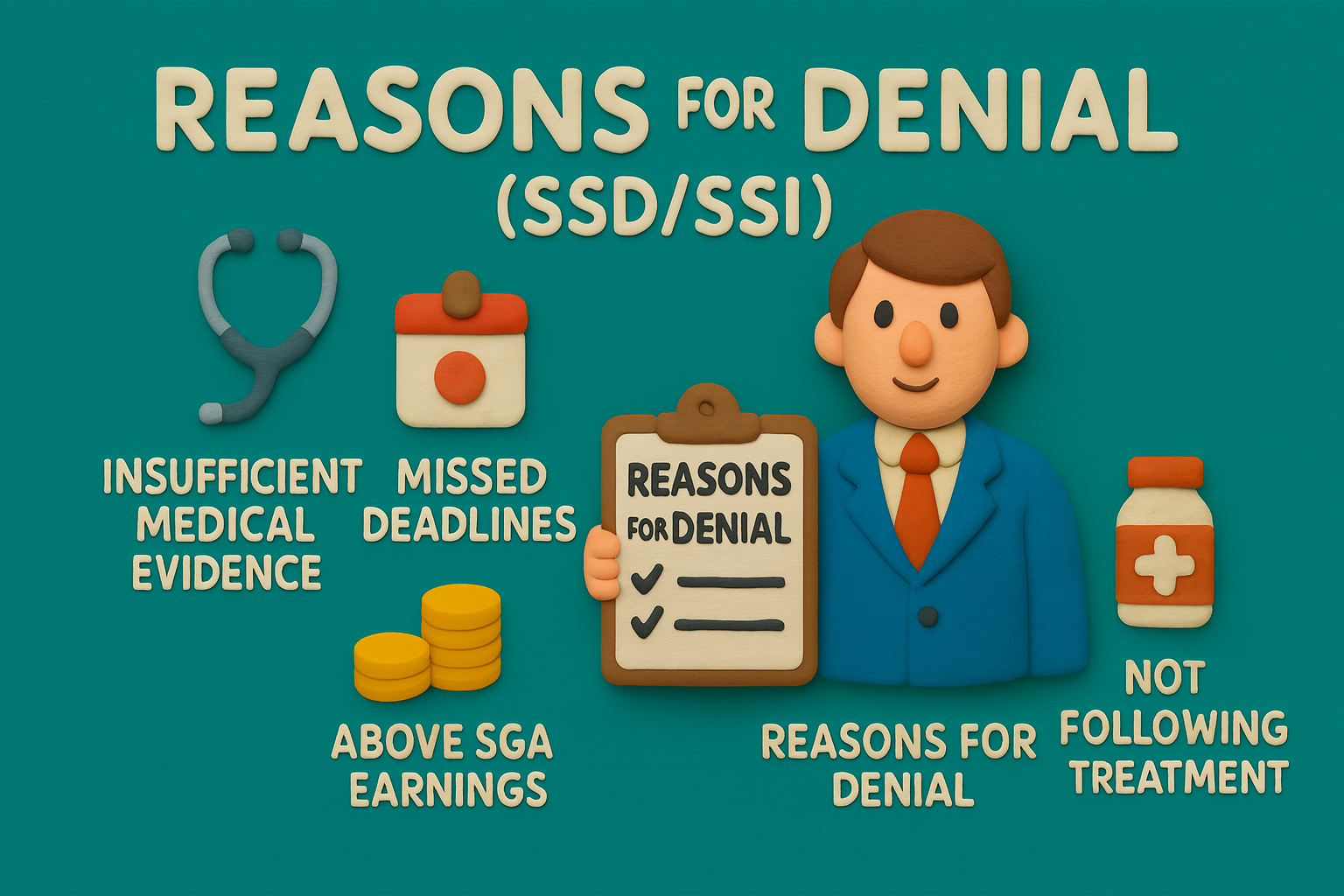
Summary: The chart highlights four frequent causes of denials: insufficient medical evidence, missed deadlines, earnings above the SGA limit, and not following prescribed treatment. Each reason is paired with an easy-to-spot icon (stethoscope, calendar/clock, coin stack, pill bottle). Use this visual to help readers identify what went wrong and what to fix on appeal.
Step 2: Hearing with an Administrative Law Judge (ALJ)
The ALJ hearing is often the heart of the SSD appeal process. If you’re denied at reconsideration (or if your state skips reconsideration – though as of recent SSA policy, reconsideration has been reinstated nationwide), the next step is to request a hearing. You have 60 days from your reconsideration denial to request an ALJ hearing. This hearing is a chance for you to present your case in person (or via phone/video) to an independent judge who was not involved in earlier decisions. It’s essentially a do-over in front of a judge, where you (and your attorney, if you have one) can explain face-to-face why you are disabled and deserve benefits.
Key aspects of the ALJ hearing:
- Setting and format: Social Security hearings are less formal than courtroom trials. Usually, they take place in a small conference room or hearing office. Besides the judge, there may be a hearing assistant, a vocational expert (an expert who testifies about jobs and work ability), and sometimes a medical expert. You will be sworn in and questioned by the judge (and your attorney can also make statements or ask you questions to draw out helpful testimony). The atmosphere is meant to be inquisitorial, not adversarial – the judge will ask questions to understand your situation. If you’re in Virginia or another state with backlogs, expect to wait several months (often a year or more) from the time you request a hearing until the actual hearing date. Important update: In recent years, phone and online video hearings have become common. The SSA has even made telephone and video hearings a standard option so claimants don’t always have to appear in person. You can choose your preferred format (in-person, phone, or video) when scheduling. Each has pros and cons; for instance, in-person can feel more personal, but phone/video can be more convenient or quicker to schedule.
- Preparation is critical: Going into the hearing unprepared is a big mistake. This is where many claims are won, because you can speak directly to the decision-maker and provide context that paper forms can’t convey. Be ready to discuss your work history, medical conditions, symptoms, daily activities, and limitations in detail. Think about the common questions asked during SSD hearings – for example, “Describe your symptoms,” “How do your conditions limit your daily life?”, “What treatments are you undergoing?” – and plan how to answer honestly and clearly. Our comprehensive guide on common questions asked during SSD hearings provides seven crucial insights and example questions to help you prepare effectively. Review your case file (including any prior testimony or forms you submitted) so your answers at the hearing are consistent with the record. It can be very helpful to do a mock hearing with your attorney or even a friend, to practice articulating your situation. Remember, the judge might have hundreds of pages of records, but hearing you describe your struggles in your own words can make a strong impact – as long as you stay truthful and focused.
- New evidence and updates: You should submit any new medical evidence to the judge before the hearing (generally, you’re asked to submit new records at least 5 business days prior to the hearing). This includes any doctor visits, tests, or treatments that occurred since the reconsideration. If you have an attorney, they will help gather and submit this. If not, make sure to send the hearing office any new records or bring them to the hearing (the judge can also keep the record open afterwards if needed). Also, update the judge on changes since the prior decision – for instance, if your condition worsened or you developed a new impairment, this is highly relevant.
- Vocational expert (VE) testimony: In most hearings, a VE will be present or on the phone. The judge will ask the VE hypothetical questions about whether someone with your limitations could do any jobs in the national economy. This testimony is pivotal because if the VE says “no jobs exist for someone like this,” you win – but if they name jobs, the judge may deny benefits. Cross-examining the VE or pointing out inconsistencies is something an experienced disability attorney does routinely. If you’re on your own, you can still question the VE, but this can be technical (involving job classifications and transferable skills). Be prepared that the judge might ask you some vocational questions too, like details of your past work.
- Your testimony: The judge will likely ask you to describe your symptoms, pain levels, daily routine, ability to do household chores, how long you can sit/stand, how far you can walk, how heavy you can lift, how your condition affects your concentration – and so on. Be very specific in your answers. Rather than saying “it’s hard to walk,” say “after 10 minutes of walking, I have to stop and rest because of severe back pain.” Provide real examples from your daily life that illustrate your limitations (e.g., “I tried grocery shopping last month, but after 15 minutes I became so dizzy I had to leave the cart and sit down.”). This paints a vivid picture for the judge. Always tell the truth. If you don’t know an answer or can’t remember, it’s okay to say so – don’t guess or exaggerate. Also, if you have good days and bad days, describe what a bad day vs. a better day looks like. Consistency with your medical records is crucial; the judge will compare your testimony with the written evidence. If you’ve kept a pain diary or activity log, that can help you recall details accurately.
- Outcomes at the hearing stage: After the hearing, you won’t get a decision immediately (the judge usually issues a written decision weeks or months later). But the hearing significantly improves your chances. As noted, about half of claims that reach a hearing are approved there. According to SSA data, nearly 46% of disability claims are approved at the hearing level, making it a critical opportunity for claimants. This statistic reflects why preparation is so important – this is your best shot at overturning the denial. If the judge issues a fully favorable decision, congratulations – your denied benefits will be reversed and you’ll be approved (we’ll discuss next steps after approval briefly later). If the judge issues an unfavorable decision (denial) or a partially favorable decision (e.g., approves you but with a later disability onset date than you claimed), you still have further appeals available (Appeals Council, and then court). But many people do win at the hearing, especially with strong evidence and representation.
Note: Due to COVID-19 and subsequent policy changes, many hearings have been held by phone or Microsoft Teams video. SSA has now made phone and video hearings a permanent option. If you prefer an in-person hearing, you can request one, but it might involve longer wait times depending on local office schedules. Discuss with your attorney which format is best for your case. The good news is that no matter the format, you get your day in “court” to tell your story. (For more on hearing preparation, don’t miss our “7 Crucial Insights” guide linked above, and consider listening to expert discussions like our firm’s podcast episode on SSD hearings, which can give you additional perspective.)
Step 3: Appeals Council Review
If you receive an unfavorable ALJ decision (i.e., the judge denied benefits again), you have the option to appeal further to the Social Security Appeals Council. The Appeals Council (AC) is a body headquartered in Virginia that reviews ALJ decisions for errors. You have 60 days from the ALJ decision to file a request for Appeals Council review.
What happens at the Appeals Council stage:
- No new hearing: Unlike the ALJ stage, you typically will not have to appear in person for the Appeals Council. The AC review is mostly a paper review. You submit a request and any supporting argument as to why the ALJ’s decision was wrong. The Council will look at the ALJ’s decision, the evidence in your file, and any legal arguments you or your representative provide.
- Grounds for review: The Appeals Council doesn’t rehear the case from scratch; they look for specific issues such as an abuse of discretion by the ALJ, an error of law, or lack of support by substantial evidence. In plain language, you’re arguing that the judge made a mistake – maybe they ignored key evidence, didn’t follow SSA’s regulations, or there’s new critical evidence that came to light. You can submit new evidence to the AC only if it relates to the period on or before the ALJ’s decision and is something that for good cause wasn’t submitted earlier. The bar for new evidence at this stage is high; generally, you want to focus on what the judge might have done wrong.
- Possible outcomes: The Appeals Council can do one of three things: (1) Deny the request – meaning they refuse to review the case, and the ALJ’s decision stands (denial final); (2) Remand the case back to a judge – sending it back for a new hearing with instructions to fix certain issues (possibly even to the same ALJ, or a new one, with guidance like “consider XYZ evidence” or “obtain testimony from a medical expert”); or rarely, (3) Overturn the decision and award benefits outright. In the majority of cases, the AC decides not to grant review, effectively upholding the ALJ denial. Only about 10-15% of requests are remanded or approved. It’s a tough stage, but if you strongly believe the ALJ erred, it’s often worth a shot. Our article on the Appeals Council review process explains how this step works and what to include in your request to improve the odds of a remand.
- Timeline: Appeals Council reviews can be slow – it may take many months (sometimes a year or more) to get a decision back from them. During this time, unfortunately, you generally won’t receive benefits (unless you were already on benefits and it was a cessation case, which is different). It’s a waiting game, and you should continue any treatments and keep documentation up to date in case of a remand.
If the Appeals Council denies review or you disagree with their decision, you have one last resort: a lawsuit in federal court.
Step 4: Federal Court Appeal
The final level of the appeals process is filing a lawsuit in federal District Court. This means taking your case outside the SSA and into the judicial system. You have 60 days from the Appeals Council’s denial (or decision) to file a civil action. At this point, it’s highly advisable to have an attorney (if you don’t already), because federal court involves complex legal briefs and procedures.
What to expect in a federal court appeal:
- You (through your attorney) file a lawsuit against the SSA (technically the Social Security Administration’s Commissioner) in U.S. District Court. There is a filing fee (around $400) which can sometimes be waived if you cannot afford it (via an application to proceed in forma pauperis).
- A federal judge will review the case record and the arguments. There is no new evidence allowed – the court strictly reviews the administrative record (everything that was before the ALJ and Appeals Council) to decide if the SSA’s decision was supported by substantial evidence and free of legal error.
- Your attorney will submit a legal brief arguing why the denial was wrong, and the SSA’s lawyers will submit a brief in defense of the decision. In some cases, there may be oral arguments, but often it’s all on paper.
- The court can either uphold the SSA’s decision, or remand (send the case back to SSA for another hearing or decision), or in rare instances, reverse and award benefits. Many federal court cases result in a remand, giving you essentially another chance at the ALJ hearing level with guidance that favors your claim (for example, the court may instruct the SSA to consider certain evidence or testimony that was previously ignored).
- If you win a remand from federal court, your case goes back to SSA’s hearing level to be re-decided in line with the court’s instructions (and often, a different ALJ will handle it). If you outright win benefits from the court (not common, but it can happen if the evidence is very clear), then the SSA will have to start paying your benefits as ordered by the court.
Pursuing a federal court case can take additional year(s), and it’s more formal. The good news is our attorneys at Harbison & Kavanagh are experienced in federal court appeals – our team has honed disability law expertise through decades of appeals at federal levels. Very few cases need to go this far, but if yours does, know that you still have a fighting chance.
Important: At any stage of this process, if you win your appeal, you could be entitled to back pay (past due benefits) from the time you originally claimed disability. That can be a substantial lump sum. This is one reason it’s crucial to stick with the process and preserve your filing date by appealing rather than restarting with a new application. As noted in our Denied SSD Claim article, appealing within the deadline preserves your original filing date, which can result in more back pay once you win.
Let’s summarize the appeal levels with a quick reference:
- Initial Application – Denied? ➡ Reconsideration (60 days to file)
- Reconsideration – Denied? ➡ ALJ Hearing (60 days to request)
- ALJ Hearing – Denied? ➡ Appeals Council (60 days to request)
- Appeals Council – Denied? ➡ Federal Court (60 days to file)
At each step, the “denied benefits” decision can potentially be overturned. Many applicants in Virginia and across the U.S. ultimately succeed at the ALJ hearing or later. The key is not to give up and to keep strengthening your case as you move through these stages.
Now that we’ve covered the technical steps of appealing, the next sections will focus on practical strategies to increase your likelihood of success, as well as how to manage life (and finances) while your appeal is pending.
Strategies for Success: Turning a Denied Benefits Case into an Approval
Overcoming a denied benefits decision often requires a combination of persistence, organization, and the right strategy. Here are powerful strategies and tips to improve your chances of success on appeal:
1. Gather and Present New Evidence Strategically
One of the most important things you can do after a denial is to bolster your medical evidence. Go over the records that were originally sent to SSA and identify what might have been missing or weak. Then:
- Get updated medical exams: If you haven’t seen a specialist for your condition, do so. For example, if you have a back injury but never saw an orthopedic surgeon or got updated imaging, now is the time. A fresh MRI result or a detailed report from a specialist can carry a lot of weight. Similarly, for mental health conditions, having a report from a psychiatrist or psychologist with testing results (like cognitive tests or depression inventories) can substantiate your claim.
- Ask for detailed doctor letters: A supportive letter or medical source statement from your treating physician can be golden. Politely ask your doctor if they can write a letter or fill out an RFC form describing your limitations in specific, work-related terms (e.g., “Patient can sit only 2 hours total in an 8-hour day due to severe pain…cannot lift more than 5 pounds…misses more than 4 days of work per month on average due to symptoms,” etc.). The SSA gives weight to doctors’ opinions, especially those from specialists who have treated you regularly. Make sure the doctor’s opinion is consistent with their own treatment notes.
- Submit evidence of any new developments: If your condition has worsened since you first applied, document it. New diagnoses or complications should be clearly presented. For instance, if you originally claimed disability for heart disease and during the appeal you suffered a stroke, that is obviously crucial new evidence. Even changes like increased dosage of medications or new treatments (physical therapy, injections, surgery) indicate your condition remains serious.
- Organize the evidence: Present it in a clear way. List out the new documents in a cover letter when you submit them: e.g., “Enclosed: Dr. Smith’s cardiology report dated X, MRI report dated Y, Physical Therapy progress notes dated Z,” etc. During a hearing, refer to specific pieces of evidence by exhibit or date to help the judge easily find them. (Our medical records in SSD appeals guide goes into depth on organizing and using medical records effectively in your case.)
Remember, quality over quantity to some extent – 20 additional pages of strong, relevant medical findings will help you more than 200 pages of older records that just repeat what’s already known. Focus on filling evidentiary gaps.
2. Continue Treatment and Document It
It’s critical to keep receiving medical treatment while your appeal is pending, if at all possible. Gaps in treatment can be used against you (the SSA might argue that your condition isn’t that bad if you’re not seeing doctors). Of course, lack of insurance or funds can be an issue – if so, note that and seek out free or sliding-scale clinics.
- Follow all prescribed treatments: Whether it’s taking medications, going to therapy, using assistive devices, or undergoing procedures – follow your doctors’ recommendations to the best of your ability. If side effects or other issues make it hard, tell your doctor so they note it in your records (and possibly adjust your treatment). Compliance shows SSA that you’re doing everything you can health-wise, and still you’re disabled.
- Therapy and ongoing care: For mental impairments, consistent therapy or counseling notes help demonstrate the persistence of your condition. For physical problems, regular visits to pain management, chiropractors, etc., can help too. Even if these treatments don’t “fix” you, they create a record that you’re trying and that the condition persists.
- Track your symptoms: Keep a journal of your day-to-day symptoms and limitations. This can help your doctors understand your condition and also help you remember specifics when testifying. For example, track headaches or seizures frequency, pain levels, tasks you had to avoid, etc. While you wouldn’t submit your personal journal to SSA, you can share it with your doctor so they include observations in medical notes (which do become evidence). It can also refresh your memory before a hearing so you can clearly illustrate how often and severely your condition affects you.
By maintaining treatment and documentation, you not only take care of your health, but you also create the evidence that might eventually tip the scales in favor of an approval.
3. Leverage Witness Statements and Daily Life Evidence
Medical records are key, but personal statements and observations from people who know you can also support your case. The SSA allows you to submit statements from family, friends, or coworkers about your limitations (these are sometimes called “third-party statements”). While these might not carry the weight of medical evidence, they can paint a fuller picture of your daily struggles:
- Third-party statements: Consider asking a few people in your life to write short letters describing what they see. For example, a former coworker could write about how you tried to continue working but had to leave early often due to pain or how your productivity declined. A family member might describe the help they now provide you with cooking, cleaning, personal care, etc., because you can’t do those like you used to. These statements should focus on observations (e.g., “I have seen John come home from work and lie on the floor due to back pain for hours… he can no longer mow the lawn or even carry groceries without assistance,” etc.). Consistency is important – their accounts should align with what you’re claiming.
- Your own statement: You will likely fill out an Adult Function Report in the application process (and possibly again during appeals). Be very detailed on those forms about your day-to-day life. Don’t downplay your difficulties out of pride; this is the time to be completely frank about what you cannot do or struggle heavily to do. If your condition varies day to day, describe a “bad day” scenario in detail. If you need help with personal care (dressing, bathing) occasionally or frequently, say so. SSA places weight on these self-reports as part of evaluating your credibility.
- Work records: If applicable, evidence like a note from a former employer about why you left (for health reasons) or excessive sick leave records can reinforce that you didn’t stop working on a whim – you stopped because you couldn’t continue. Sometimes HR documents or disability insurance claim forms from your job (if you filed one) can be used to corroborate your disability.
Using these additional pieces of evidence can humanize your case. They give context to the medical data and help an adjudicator see the real-world impact of your condition. For example, a medical record might show “moderate degenerative disc disease” – but a letter from your spouse saying “I have to help him put on his socks and shoes every morning because he can’t bend that far” translates that moderate disc disease into a daily functional limitation. We often recommend this approach as one of 7 powerful strategies to reverse a denial – reinforcing the case with qualitative evidence from your life.
4. Avoid Common Mistakes During the Appeal
When fighting a denied benefits decision, be mindful to avoid pitfalls that can derail your appeal. Here are some common mistakes – and how to avoid them:
- Missing Deadlines: We can’t stress this enough – always appeal before the 60-day deadline (plus 5 days mailing time) expires. If you even think you might want to appeal, file the appeal to preserve your rights, because missing that window usually means starting over. Mark your calendar, set reminders, and send in appeal paperwork with proof (if mailing, use certified mail or get a receipt; if online, save the confirmation). If you have an attorney, they will track this, but if not, it’s on you.
- Filing a New Application Instead of Appealing: Some people, feeling discouraged, file a brand new application after a denial. This can be a mistake because you lose your protective filing date and any accumulated backpay from the first application, and you’ll start from scratch (often with the same outcome unless something changed). Generally, appeal instead of reapplying – unless you missed the appeal deadline or have been advised to reapply due to a fundamentally different situation. Always consult with a knowledgeable SSD lawyer if you’re unsure whether to appeal or re-file; in nearly all cases, pursuing the appeal is the better choice.
- Continuing to Work (above SGA) while appealing: Financially, you might be in a tight spot (we discuss financial tips later), but be cautious about working too much during an appeal. If you return to substantial work and earn over the limit, the SSA might determine that your appeal is moot because you no longer meet the definition of disability (which requires inability to work at SGA level). Working small odd jobs or part-time below the limit might be okay (and sometimes necessary to survive), but always report any work activity to SSA. If you’re unsure, talk with your attorney. There are instances you can work and still claim benefits (e.g., trial work periods after approval, or marginal employment), but during an active appeal, significant work can undermine your case. Our financial tips while waiting for SSD benefits article explores alternatives for income and assistance that won’t jeopardize your disability claim.
- Not Communicating or Updating Contact Info: Some appeals get derailed simply because the SSA or hearing office couldn’t reach the claimant. Always update your address and phone number with the SSA if you move or change numbers. Check your mail (including spam folders for any email communications, though most official notices come by postal mail). If you get a notice to attend a medical exam or hearing and fail to show up because you didn’t see the letter, your case could be dismissed. Stay vigilant with communications. (For pointers, refer to our earlier tips and the communication strategies guide linked.)
- Emotional Venting to SSA: It’s understandable to feel angry or heartbroken by a denial. However, when communicating in writing or in person with SSA, remain professional and factual. Ranting about the system or expressing hostility can backfire. Focus on the facts of your condition and why the decision should be changed. Save the venting for a support group or personal conversations – keep official communications respectful and to the point. Remember, SSA employees and judges are people too; presenting yourself as a cooperative and earnest individual can only help.
- Ignoring Your Own Limitations in the Hearing: Some claimants, perhaps out of pride or nervousness, downplay their disabilities when talking to the judge. For example, when asked about daily activities, they might say “I can do most things, just slower” when in reality they struggle heavily or need help. This is not the time for pride. Be honest about what you cannot do. Don’t exaggerate, but don’t leave out or sugarcoat either. If an activity is painful or you need breaks, describe it that way. You are not complaining; you are informing the judge of your reality. Failing to communicate the true extent of your limitations is a major mistake. Practice describing your limitations in a straightforward way. If this is hard for you, it’s something an attorney or advocate can help with – they’ll often know how to ask you questions that elicit the necessary details.
By steering clear of these errors, you keep your appeal on track and maintain credibility. In our experience, small mistakes can have big consequences in disability cases, so approaching the process carefully and knowledgeably is important. That’s why having experienced guidance can make a difference – which brings us to our next strategy.
5. Consider Legal Representation
While you have the right to pursue a Social Security appeal on your own, having an experienced Social Security Disability attorney in your corner can significantly improve your chances of success. Here’s how an attorney can help turn a denied benefits case around:
- Case evaluation and strategy: A lawyer experienced in SSD law can quickly pinpoint why your claim was denied and know exactly what is needed to fix it. They will review your SSA file (including all the medical records and SSA’s notes) to craft a targeted plan – whether it’s gathering a specific type of evidence, getting a doctor’s statement, or preparing legal arguments about how your case meets certain regulations or rulings. This kind of analysis is hard to do on your own if you’re not familiar with SSA’s rules. Our attorneys often identify overlooked details or technical errors that can be leveraged on appeal (for example, an ALJ failing to give proper weight to a treating physician’s opinion – a common error that can win a remand if argued properly).
- Paperwork and deadlines: Your attorney and their staff will handle filing the appeals forms, writing legal briefs for the hearing or Appeals Council, and making sure nothing falls through the cracks. No more worrying about calculating deadlines or which form to send – they’ve got it covered, which gives you peace of mind to focus on your health.
- Evidence gathering: We will contact your doctors to obtain any missing records and often ask them to provide opinions or fill out questionnaires tailored to SSA’s criteria. Doctors sometimes respond better to formal requests from law offices, and we know which medical statements carry weight. If medical evidence is still insufficient, we might suggest additional evaluations (for instance, a neuropsychological test for cognitive issues, or a functional capacity evaluation). We’ll also compile everything logically and submit it to SSA with clear labels so the evidence is hard to ignore.
- Preparing you for the hearing: Perhaps one of the biggest benefits is preparation for the ALJ hearing. A good disability attorney will meet with you (often multiple times) before the hearing to go over likely questions, coach you on how to phrase answers honestly but effectively, and address any weak points in your case. We may run through a mock hearing so you know what to expect. This process greatly reduces anxiety and helps you present your case in the best light. When you know how to answer tough questions (like “Why can’t you do a sit-down job?” or “How do you spend your day?”), you avoid pitfalls and make the judge’s job easier in understanding your limitations.
- Questioning experts and legal arguments: During the actual hearing, your attorney will handle questioning the vocational expert or any medical expert. For example, if a vocational expert says you could still do a certain job, we can cross-examine by pointing out limitations that, when added, might eliminate those jobs. We ensure the hypotheticals considered reflect all of your limitations. We also make any legal arguments – such as if your condition equals a listed impairment or if the ALJ’s hypothetical is missing something important – either at the hearing or in a pre- or post-hearing brief. These are nuanced points that can win a case, but a self-represented claimant wouldn’t usually know to argue them.
- No fee unless you win: Social Security attorneys work on contingency, meaning you pay no upfront fees and owe no fee at all if we don’t win your case. If we do win, the fee is regulated by law – typically 25% of the back pay, capped at a certain amount (currently $7,200 as of 2025). This means everyone can afford representation; you don’t pay out-of-pocket, it comes from the past-due benefits the SSA awards you. Considering the difference professional help can make, it’s an investment that often pays for itself.
Statistically, claimants represented by attorneys have higher success rates, especially at the hearing level. Our own team at Harbison & Kavanagh has over four decades of combined experience helping claimants in Richmond and across Virginia navigate appeals. We’ve handled thousands of disability cases and seen nearly every scenario. Whether it’s a straightforward medical denial or a complex case involving multiple conditions and prior appeals, we bring that experience to bear to give your appeal the best possible chance.
If your claim has been denied, we strongly encourage you to reach out for a free consultation. We can evaluate your denial, explain your options, and if you choose, immediately get to work filing your appeal and developing a winning strategy. (Contact information and next steps are provided at the end of this article.)
6. Manage Financially (and Emotionally) While You Appeal
Appealing a denied benefits decision can take many months or even a couple of years, depending on how far you have to go. The wait can put serious financial strain on you, since you’re unable to work and not yet receiving disability benefits. It’s a difficult Catch-22: you can’t get benefits because they say you can work, but you know you truly can’t work to earn income. Here are some financial tips while waiting for SSD that might help you stay afloat and sane during this period:
- Budget and cut unnecessary expenses: It might sound obvious, but creating a bare-bones budget is essential. List out all your essential expenses (housing, utilities, groceries, medications) and see if there are any non-essentials that can be paused or eliminated while you’re waiting (streaming services, subscriptions, etc.). Our article on financial tips while waiting for SSD suggests detailed budgeting as a starting point. The idea is to stretch whatever savings or support you have. If you have debts, consider contacting creditors to explain your situation – some may offer hardship programs, deferments, or lower payment plans when they know you’re awaiting disability income.
- Explore assistance programs: Don’t hesitate to apply for other aid. Depending on your situation, you might qualify for needs-based assistance like food stamps (SNAP), Medicaid for healthcare, energy assistance, housing vouchers, or local charity programs. Many communities have nonprofits that help disabled individuals with bills, food banks for groceries, etc. Also, check if your state offers interim assistance for those awaiting SSDI/SSI decisions (some states have small programs). While these won’t replace an income, they can alleviate specific burdens. For instance, getting Medicaid can cover your medical costs while you have no income, which is huge. If you’re in Virginia, applying for Medicaid and SNAP through CommonHelp or contacting Virginia 211 can connect you with resources.
- Loans or advances carefully: Some folks consider borrowing money (from family, friends, or even tapping retirement accounts or taking personal loans) to get by. Be very cautious with high-interest loans or credit card debt – you don’t want to create a financial hole that even backpay won’t fill. If family can help interest-free, that’s safer. There are also companies that offer advance cash in exchange for a portion of your future disability backpay; these can be predatory, so read the fine print or consult a lawyer before considering such options. In extreme cases, some claimants have to consider bankruptcy due to medical bills or other debts – if that’s on the table, get legal advice on how it might intersect with your potential disability backpay.
- Part-time work under the limit: Many ask, “Am I allowed to try working while waiting?” You can attempt some work as long as your earnings stay below the SGA threshold (for 2025, roughly <$1,470/month for non-blind). Doing a small part-time job or freelance gig might help you survive, and it does not automatically void your disability claim if under SGA. However, proceed with caution: any work you do will be scrutinized by SSA. If you work, keep it minimal and document your difficulties doing it (e.g., you had to reduce hours or you stopped after a short period because of your condition). If you manage to sustain a part-time job long-term, SSA might argue you could do more. It’s a fine line. Ideally, consult with your attorney about any plans to work or current financial desperation – there might be case-specific advice. Also, note that if you do earn a little, you must report it to SSA. Some judges may view a bit of work as you being a fighter trying to support yourself (which is commendable), but if it’s too much or too easy for you, it could signal you’re not as disabled as claimed. Every case is unique here.
- Stay healthy without breaking the bank: Continue taking care of your health as much as you can – after all, your health is at the center of your case. If you lost insurance, look into free clinics, prescription assistance programs (many drug manufacturers have programs for free/low-cost meds if you can’t afford them), and community health centers. Taking your medications and doing what treatment you can will keep you in better shape for the fight ahead and also show SSA you’re actively managing your condition.
- Emotional support: The financial and physical stresses of a disability appeal can be overwhelming. Depression and anxiety are common when one’s livelihood is on the line. Seek support – whether it’s a therapist (if you can access one), a support group (there are disability support forums online, as well as local groups), or simply leaning on friends/family emotionally. The process can make you feel isolated; connecting with others who understand (even online communities of people who went through SSA appeals) can provide coping tips and moral support. Remember that waiting for a hearing or decision is often the hardest part – but you’re waiting for something that could profoundly change your life for the better (monthly benefits and health coverage).
- Check your appeal status regularly: As mentioned earlier, keep tabs on where your case is. You can call the SSA or hearing office every couple of months to ask if there’s any update or if they need anything from you. The SSA also has an online status check for appeals through your mySocialSecurity account. This proactive approach ensures, for example, that you don’t miss a scheduling notice or that your file hasn’t fallen through the cracks. Our blog on how to check the status of your SSD appeal shows how to use these tools. It’s rare, but sometimes hearings get scheduled and notice letters get lost – you do not want to miss your hearing because you never knew about it. A quick phone check-in can prevent that nightmare scenario.

Caption: Stay Afloat While You Appeal
Summary: A worried piggy bank is surrounded by practical, time-saving tips to manage money during the appeal wait—set a budget, call utilities about payment plans, use coupons, apply for aid (e.g., Medicaid/SNAP), avoid high-interest loans, and check your case status. A supportive figure (attorney/advocate) reinforces that help is available. The graphic turns stressful waiting time into a clear, actionable checklist.
::contentReference[oaicite:0]{index=0}
Lastly, keep your eyes on the prize: if you win, you could receive a significant retroactive payment (backpay) that can dig you out of debt and hardship. Many clients tell us that their first disability check, including backpay, allowed them to pay off accumulated bills and finally breathe a sigh of relief. That day will come – perseverance is key.
Your Next Steps After a Denied Benefits Letter: Recap and Action Plan
Let’s recap the essential actions you should take if you’ve been denied benefits on your Social Security Disability claim:
- Don’t panic, but do act promptly. Mark the 60-day appeal deadline on your calendar. Decide to appeal and prepare the necessary forms (Request for Reconsideration or Request for Hearing, depending on your stage). The sooner you file, the sooner the appeal process starts. Remember, not appealing is essentially giving up potential benefits. Most people are denied at first – the system expects you to appeal.
- Analyze the denial reasons. Identify whether it’s medical or technical or both. This will shape your approach. For medical denials, plan to strengthen medical proof. For technical denials, figure out if it’s correctable (e.g., earnings too high – can that be resolved? or lack of credits – maybe you applied under the wrong program and should apply for SSI?).
- Consult with a Social Security Disability attorney (free consultation). Even if you’re unsure about hiring one, an initial consultation can provide valuable insight. A lawyer can tell you the viability of your case, any weak points, and how they’d tackle it. There’s no obligation, and you’ll be more informed. If you do partner with an attorney, they will take over many tasks and guide you step by step, greatly reducing the stress on you.
- Begin gathering supporting evidence. Contact doctors for records and letters, keep ongoing appointments, and update your personal records of symptoms. If there were any tests or referrals you put off, try to complete them now. New diagnostics or treatments can show the SSA that things are more serious than initially thought.
- Write an appeal letter or statement (or have your attorney do so). This is your opportunity to directly address the adjudicator: summarize why the denial was mistaken and how your condition does meet the rules. Keep it professional and focused. Cite specific evidence if you can (e.g., “Contrary to the initial decision, I cannot stand for more than 10 minutes. Dr. Jones’ report dated 5/5/2025 confirms my severe neuropathy and balance issues, which is new evidence since my application.”). If writing isn’t your strength or you’re unsure what to say, again, an attorney or advocacy group can help.
- File the appeal and confirm receipt. Whether online or by mail, ensure the SSA acknowledges your appeal was received. If you file online, you’ll get a confirmation page – print or save it. If by mail, consider calling to confirm after a couple of weeks or mail it with tracking. The SSA losing an appeal filing is rare but can happen; you don’t want to assume it’s in process only to find out later it never reached them.
- Prepare for the next phase (reconsideration review or hearing). If at reconsideration, it’s mostly about submitting evidence and waiting for a new decision by a different examiner. If heading to a hearing, use the waiting time to prepare thoroughly: continue gathering evidence, think through your testimony, and make sure you or your attorney subpoena any crucial documents or witnesses in advance if needed. The SSD appeal process guide can help you understand each upcoming step in detail so you feel more in control.
- Take care of yourself in the interim. Follow the financial coping tips discussed. Keep your support network close. Use resources available to you. The appeals journey can be long, but many have walked it before and made it to the finish line successfully.
- Stay informed on your case. If months pass with no word (especially at the hearing level), periodically check in. If you have representation, they will often do this for you and update you when news comes (for example, when your hearing is scheduled, they’ll let you know immediately). If you’re unrepresented, you can call the Office of Hearings Operations to ask if a hearing date has been set or where you are in line.
- Never lose hope. A denial can feel like a personal rejection, but it’s often just a bureaucratic hurdle. Thousands of people every year overturn denials and get the benefits they need. Staying persistent is often the deciding factor. As long as you keep fighting – gathering evidence, meeting deadlines, telling your story – you have a real chance at success.
Conclusion: Denied Benefits Doesn’t Mean Defeated – We Can Help
Facing a denied benefits letter from Social Security can be overwhelming. You’re dealing with health challenges, financial stress, and now a complex appeals process. It’s normal to feel discouraged. But remember the statistics and insights shared here: most people have to appeal to win, and many do win at those later stages. The Social Security Disability system is rigorous, often requiring claimants to prove their case multiple times. By educating yourself with guides like this and seeking support, you are already taking powerful steps toward turning that “No” into a “Yes.”
At Harbison & Kavanagh, we have a passion for helping hard-working individuals in Virginia secure the Social Security Disability benefits they’ve earned. We understand the frustration of a denied SSD claim – and we have the legal expertise to tackle it head-on. Our Richmond Social Security Disability attorneys have successfully represented countless clients through reconsiderations, ALJ hearings, and appeals, even up to the federal court level. We know the common pitfalls, the medical nuances, and the legal arguments that can make the difference. When your benefits have been denied, you deserve authoritative yet compassionate guidance – and that’s what we strive to provide every client.
If your SSD claim was denied, don’t give up. Instead, take action. You have the right to appeal and the right to have an advocate by your side during this fight. The sooner you start, the sooner you could be on your way to an approval and receiving those much-needed benefits. Imagine a future where the monthly disability checks arrive, easing your financial burden, and you have Medicare or Medicaid to help with healthcare costs. That future is what we’re working toward.
Next Step: Reach Out for Help – We invite you to contact our team for a free consultation about your denied disability claim. We’ll review your situation, answer your questions, and outline a plan to move forward. There’s no obligation, just information and support. Let us shoulder the legal complexities so you can focus on your health.
In summary, a denial is not the final word. With determination, evidence, and possibly some professional help, you can navigate the Social Security Disability appeals process and greatly improve your odds of success. Use the knowledge and resources provided in this guide as your starting point. And if you ever feel lost or unsure, remember that help is available – you do not have to go through this alone.
Take charge of your appeal today and turn those denied benefits into the approval you need. Your perseverance now can pay off in financial stability and peace of mind down the road. Good luck, and don’t hesitate to reach out if we can assist in any way on your Social Security Disability journey!
Don’t delay any longer, contact our SSD lawyers at 804.888.8000 to set up a free consultation today! We are located in Richmond, VA.
We proudly serve the residents of Virginia and the surrounding states.
We Bring More Experience to Your Rescue
Dynamic Legal Representation You Deserve
Our Richmond workers’ compensation lawyers have handled thousands of cases on behalf of injured and disabled workers in the Commonwealth of Virginia. There is very little we have not seen in terms of medical conditions in the context of a disability claim. Our depth of knowledge of the law has been honed through extensive appeal experience at the Federal Court level.


