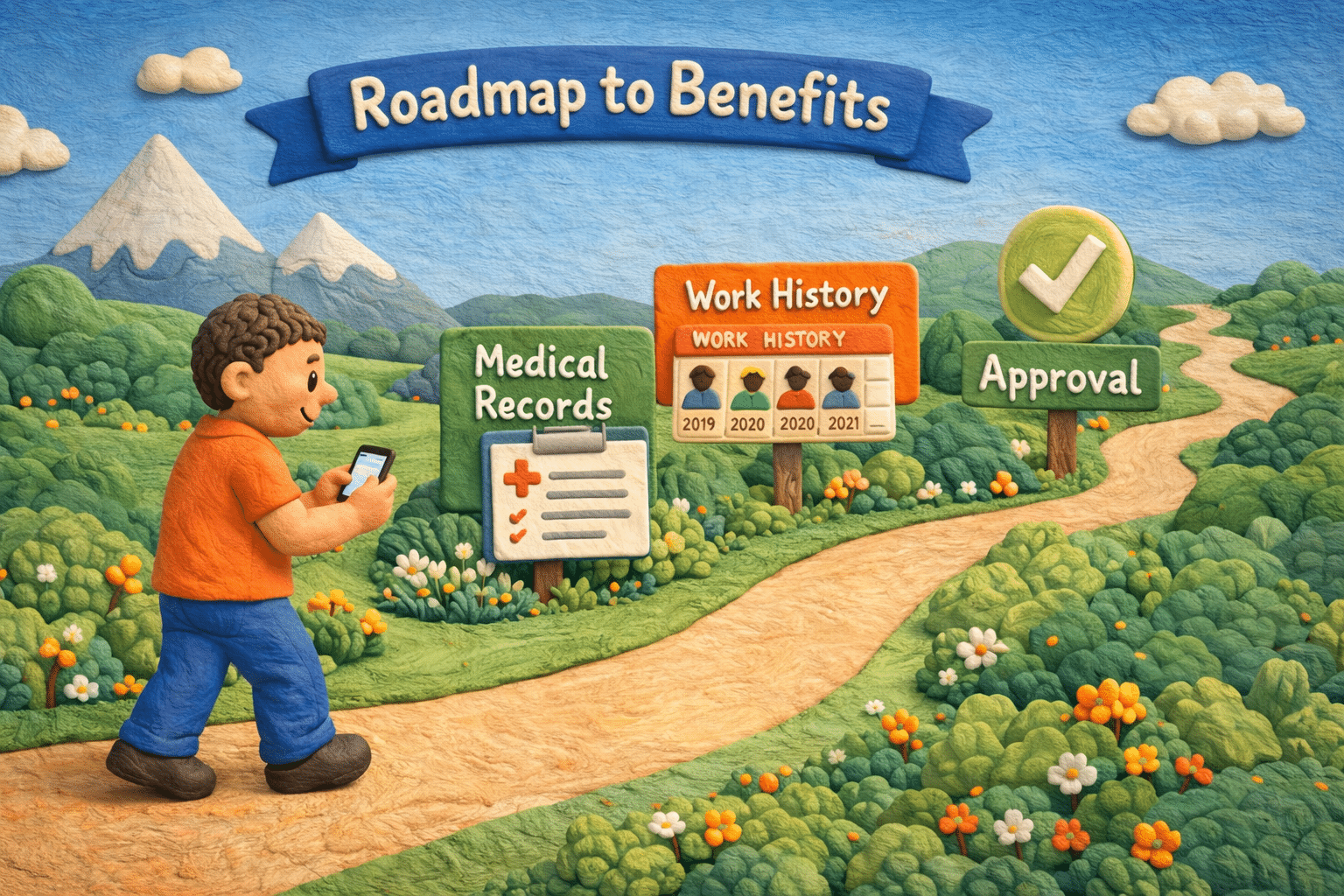
Understanding how the Social Security Administration (SSA) evaluates medical conditions is the first step toward…

6 Critical Questions to Ask Before Filing Your SSD Application
6 Critical Questions to Ask Before Filing Your SSD Application
- Introduction
- Why Planning First Saves Months
- Question 1: Am I Working Above SGA?
- Question 2: Do My Conditions Meet or Equal an SSA Listing?
- Question 3: Is My Medical Evidence Current, Complete, and Consistent?
- Question 4: Can I Prove My Functional Limits (RFC)?
- Question 5: Do I Qualify Financially—SSDI Work Credits or SSI?
- Question 6: What Is My Alleged Onset Date—and Does My Timeline Support It?
- Common Pitfalls We See in Virginia
- FAQs
- Podcast: 6 Critical Questions Before You Apply
- Helpful Next Steps
- Talk to a Virginia SSD Lawyer
>
Introduction
Filing a Social Security Disability (SSD) application isn’t just typing answers into a form. The Social Security Administration (SSA) evaluates disability using strict rules, and success often comes down to how well your evidence is organized before you apply. Think of your application as a curated case file: a clear story about your medical conditions, how they limit you, and when those limits began affecting your ability to work.
This guide walks you through six questions every Virginian should answer first. Each question includes practical checklists, examples, and strategy tips we’ve learned from helping thousands of clients across the Commonwealth. If you work through these steps, you’ll submit a stronger application, reduce avoidable delays, and set yourself up for success if an appeal becomes necessary.

Summary: How SSA evaluates disability at a glance.
Why Planning First Saves Months
Filing Your SSD Application: Key Considerations
The SSA’s five-step process looks at work activity, medical severity, whether you meet or equal a listed impairment, and whether you can perform past work or other work. Rushing in with scattered records, outdated tests, or unclear dates creates bottlenecks that can take months to fix. Careful planning—especially around your earnings, evidence, and onset date—prevents the most common slowdowns we see in Virginia claims.
Want a high-level refresher on the overall process? Review our overview of the SSD application process and then come back to these six questions to tighten your strategy.
Question 1: Am I Working Above SGA?
SSA’s process starts by asking whether you’re working at a level the agency calls “substantial gainful activity” (SGA). If you’re consistently over SGA, SSA typically stops the analysis right there. If you’re under SGA—or not working—your claim proceeds to a medical review. This first gate is critical because it’s purely about earnings, not diagnoses.
How to evaluate SGA before you apply:
- Gather 12 months of pay documentation. Include paystubs, W-2s/1099s, and any invoices if you’re self-employed.
- Track month-by-month totals. If hours fluctuate, a clean monthly log helps show patterns instead of snapshots.
- Document accommodations. Notes about extra breaks, reduced quotas, or reassigned duties help clarify why pay may not reflect full work capacity.
Gray areas in Virginia cases: We often see clients who cut back hours or switch to lighter duties but still bounce around the SGA line. Clarity is everything. If you’re near SGA, we’ll help you present your real-world functioning accurately so the reviewer sees why your work is not competitive, sustainable, or both.
Question 2: Do My Conditions Meet or Equal an SSA Listing?
At Step 3, SSA considers whether your impairment meets or equals a listed impairment in the agency’s medical criteria (the “Blue Book”). Meeting a listing can fast-track approval, but listings are technical and evidence-heavy. The right strategy is to identify which sections might fit and make sure your testing and specialist notes match what SSA looks for.
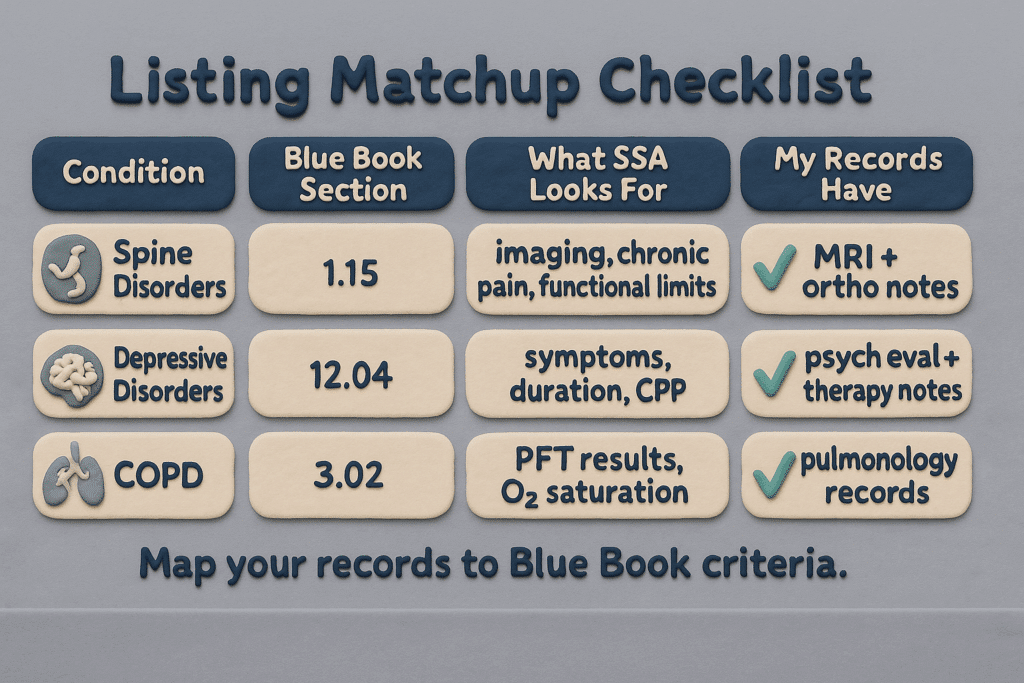
Summary: Map your records to Blue Book criteria.
Practical steps:
- Identify candidate listings. Use the SSA Listing of Impairments (Blue Book) to find sections that align with your diagnoses—e.g., musculoskeletal, respiratory, neurological, mental disorders, immune system disorders.
- Compare your records to the listing elements. Listings often require specific test results, durations, or repeated observations (e.g., imaging, pulmonary function testing, neurocognitive evaluations, lab results).
- Fill the gaps before you apply. If you’re missing a required test, ask your provider about ordering it now so it’s in your chart by the time a claims examiner reviews your file.
Strategy tip: Even if you don’t meet a listing exactly, your file can still win via Residual Functional Capacity (RFC). Don’t abandon good RFC evidence just because you’re not a perfect listing match—many approvals hinge on credible functional limits.
Question 3: Is My Medical Evidence Current, Complete, and Consistent?
Most denials trace back to evidence problems: outdated visits, gaps in treatment, or records that contradict each other. Your goal is a file that reads like a clear, continuous story: diagnosis → treatment → response → ongoing limitations. Quality beats quantity, but timeliness and consistency matter.
Build a file reviewers can trust:
- Update core providers in the 60–90 days before filing. Primary care, key specialists, therapy/mental health—recent notes validate that your limitations persist.
- Centralize critical tests and imaging. Make sure MRIs, CTs, EMGs, pulmonary tests, neurocognitive evals, or lab series appear in the provider’s chart and are easy to find.
- Document treatment response and side effects. Many conditions wax and wane; notes about flare frequency, medication intolerance, and failed therapies show why you can’t sustain work.
- Keep a simple symptom journal. Dates, durations, triggers, recovery time, and any activity modifications help translate medical jargon into day-to-day impact.
Consistency check: If physical therapy notes show high activity levels while your primary care notes say you can barely walk, a reviewer will wonder which is accurate. Resolve contradictions now—ask providers to clarify changes over time so your file tells a coherent story.
Question 4: Can I Prove My Functional Limits (RFC)?
RFC is the bridge between medical conditions and employability. It answers questions like: how long can you sit, stand, or walk? How much can you lift or carry? How often would you miss work? For mental impairments, RFC addresses concentration, persistence, pace, stress tolerance, and social interaction. Many adult approvals come down to credible RFC evidence, not a listing.
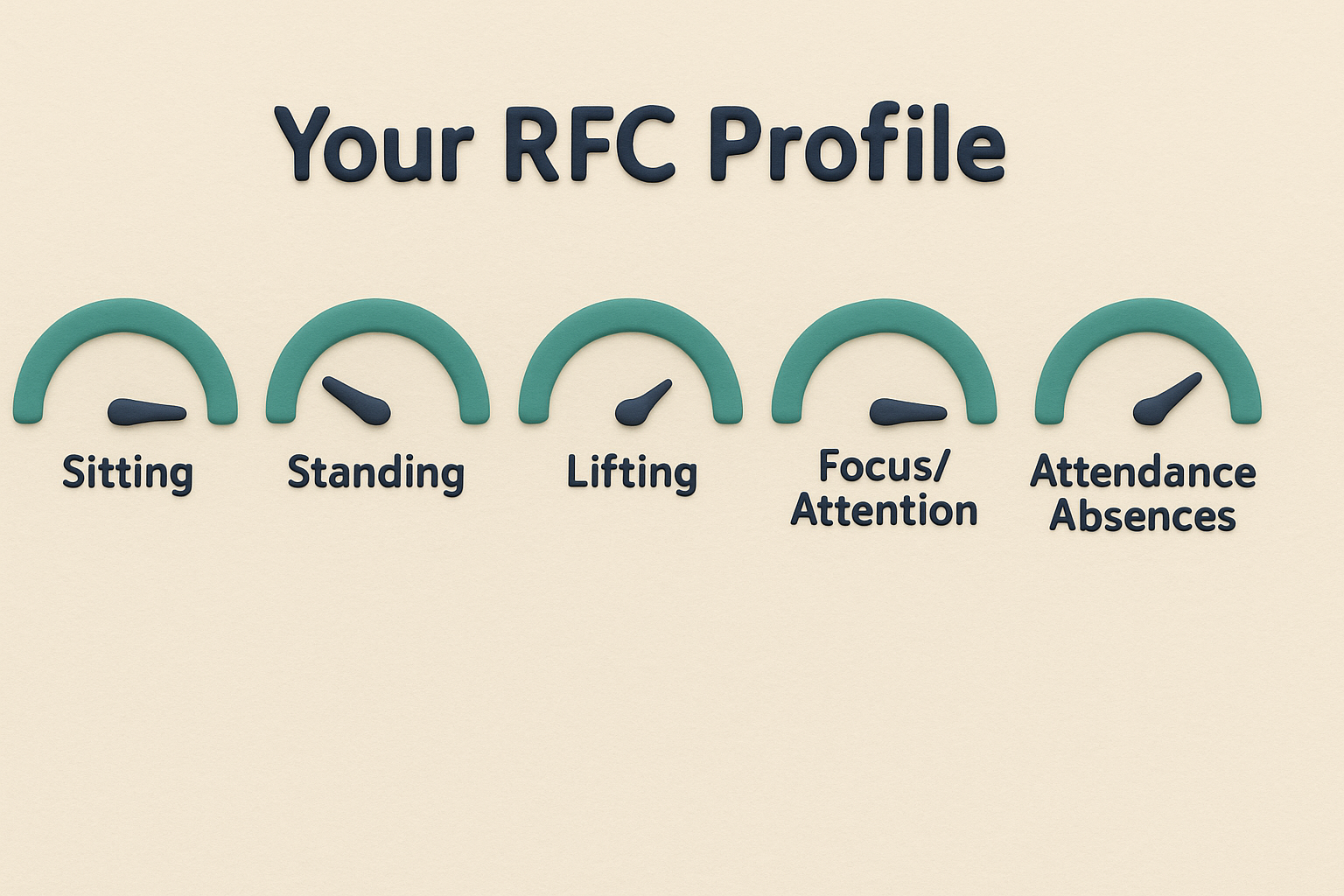
Summary: Translate symptoms into work-related limits.
Ways to strengthen RFC before filing:
- Objective testing where appropriate. A Functional Capacity Evaluation (FCE) can quantify endurance and strength; neuropsychological testing can quantify attention and memory limits.
- Treating-source opinions. Ask providers to document practical limits (e.g., need for unscheduled breaks, off-task time, absenteeism, postural and manipulative limits) in language SSA understands.
- Third-party corroboration. Statements from family or former supervisors can connect the dots between symptoms and real-world functioning.
Make RFC specific. Vague statements like “can’t work” carry little weight. Concrete limits—“must alternate sitting and standing every 15–20 minutes,” “would miss two or more days per month,” “can’t maintain pace without extended breaks”—are more persuasive because they map directly to job requirements.
Question 5: Do I Qualify Financially—SSDI Work Credits or SSI?
There are two main disability programs. SSDI (Social Security Disability Insurance) depends on your work history and insured status. SSI (Supplemental Security Income) depends on financial need. Some people qualify for both. Getting this right before you apply determines which rules and proofs matter most.
SSDI preparation:
- Verify your work credits and Date Last Insured (DLI). You can check through your “my Social Security” account or a prior SSA notice. If your DLI is near—or has passed—you’ll need evidence showing you were disabled on or before that date.
- Collect earnings records. Work history summaries, W-2s/1099s, and job descriptions help the examiner understand your past work demands and why you can no longer meet them.
SSI preparation:
- Organize financial records. Bank statements, information on household contributions, and resource values help prove need-based eligibility.
- Clarify living arrangements. SSA looks at who you live with and who pays for food and shelter; clear documentation avoids follow-up delays.
Mixed cases: If you qualify for both SSDI and SSI, apply for both. The combination can protect benefits while SSA decides your claim, and it can affect how medical and financial development proceeds during the review.
Question 6: What Is My Alleged Onset Date—and Does My Timeline Support It?
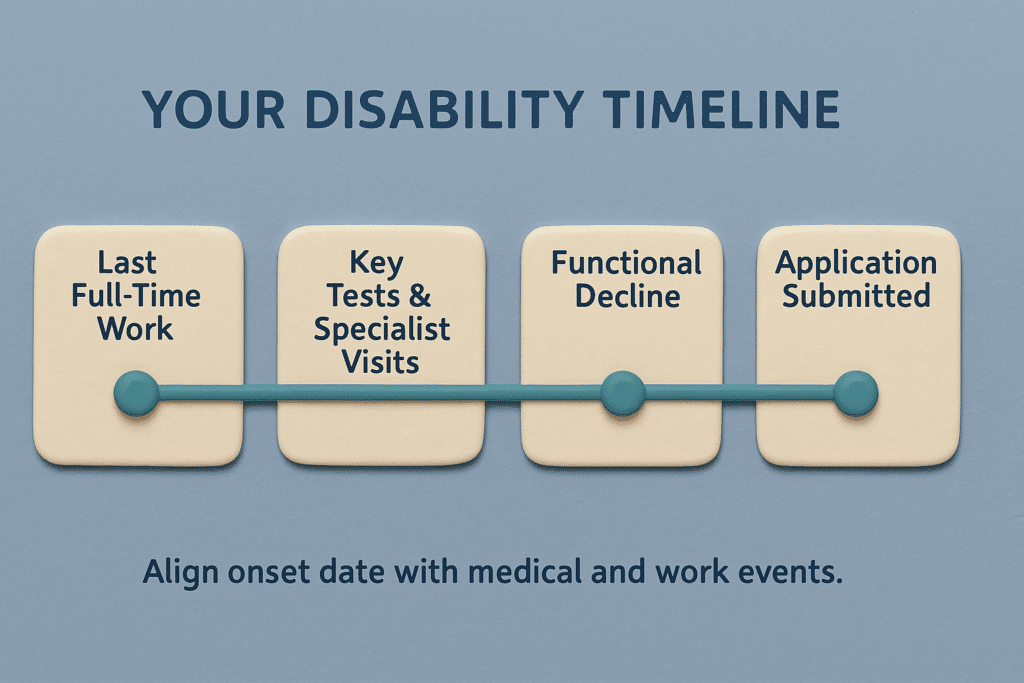
Summary: Align onset date with medical and work events.
Your alleged onset date (AOD) is the date you became unable to sustain full-time, competitive work. It drives the entire case: which records matter most, whether you’re insured for SSDI, and how back pay is calculated. Picking the right AOD is a strategy decision, not a guess.
How to choose a defensible AOD:
- Anchor it to objective events. Common anchors include the last day of full-time work, a major diagnostic test, a hospitalization, a failed return-to-work attempt, or an escalation in treatment (e.g., surgery).
- Be consistent with earnings and records. If your AOD is June but paystubs show steady full-time wages through August, explain the mismatch or pick a later date that fits the evidence.
- Mind the DLI. If your SSDI DLI is approaching, make sure your file contains pre-DLI documentation showing the functional limits that keep you from working.
Why timing matters in Virginia: Specialist appointments and testing can take weeks to schedule. If you need updated imaging or evaluations to support your AOD, start that process now so results are in your chart before the examiner looks at your file.
Common Pitfalls We See in Virginia
1) Filing with stale or incomplete records. If your last specialist visit was a year ago, update it first. Recent notes show ongoing severity and help avoid consultative exams that may not reflect your worst days.
2) Confusing a diagnosis with disability. SSA doesn’t award benefits for a diagnosis alone. The question is whether, despite treatment, your conditions prevent sustained work. That’s why RFC proof is so important.
3) Picking an onset date that doesn’t match the evidence. Choose an AOD the records will support—then make sure pay history and provider notes tell the same story.
4) Ignoring mental health symptoms. Anxiety, depression, PTSD, and cognitive issues can be disabling alone or in combination with physical impairments. Include therapy notes, medication history, and functional observations from providers.
5) Overlooking side effects and flare patterns. Drowsiness, GI issues, migraines, or post-exertional crashes can destroy work attendance and pace; if they’re not in the chart, they may as well not exist.
6) Assuming “trying to work” ruins your case. Many clients attempt light duty or part-time work and still qualify if they can’t sustain competitive levels. Document the attempt carefully—why it failed, how often you missed, and what accommodations were needed.
FAQs
Do I have to quit my job before I apply?
No. You can apply while working, but if your earnings are consistently above SGA, SSA will usually deny at Step 1. If you’re near SGA, talk with us about how to present your real-world limits and accommodations.
What makes an RFC statement persuasive?
Specific, work-related limits tied to medical findings. For example, needing to alternate positions every 20 minutes, being off task 15% of the day due to pain or brain fog, or missing two or more days a month despite treatment.
How current should my records be?
We recommend updating core providers in the 60–90 days before you file. That proves your limitations are ongoing and reduces the odds of an avoidable delay or a consultative exam that misses the mark.
Do I need to meet a Blue Book listing to win?
No. Many approvals are based on RFC and vocational rules, especially for combined impairments. Still, checking the Blue Book helps you request the right tests and notes.
What if I have both physical and mental conditions?
SSA evaluates the combined effect. Make sure both sets of records are current and that your providers document how symptoms interact—for example, pain flares aggravating anxiety or poor sleep worsening concentration.
Is there a best time of month or year to file?
No special calendar advantage, but filing after you’ve updated key records and clarified your AOD generally produces cleaner, faster development of the claim.
Podcast: 6 Critical Questions Before You Apply
Prefer to listen instead of read? Our latest podcast episode breaks down the same six questions you see here—perfect for your commute or while handling errands. We walk through how to check if you’re working above SGA, what to know about SSA listings, how to organize your medical records, and how to prove your functional limits (RFC). Plus, we explain SSDI vs. SSI eligibility and how to choose the right onset date.
Helpful Next Steps
- Map your evidence to the SSA framework. Use our SSD application process page as a checklist for what to gather.
- Verify program fit. Decide whether you’ll file for SSDI, SSI, or both, and line up the specific documents each requires.
- Check official criteria. For medical listings and program rules, start with SSA’s site: SSA Disability Benefits.
Talk to a Virginia SSD Lawyer
At Harbison & Kavanagh, we help Virginians build strong SSD applications and appeals every day. If you’re ready to apply—or want us to review your evidence first—call (804) 888-8000 or reach us through our contact page. We’ll help you choose a defensible onset date, avoid SGA traps, and present RFC limits in the language SSA expects.
Related Posts