
Key Takeaways: Your 2026 SSD Application Quick-Start Guide High Denial Risk: Approximately 65% of initial…

Understanding SSDI vs SSI: 7 Critical Differences You Need To Know
Understanding the distinction between SSDI vs SSI is crucial for Virginia residents seeking disability benefits. These two programs, while both administered by the Social Security Administration, serve different purposes and have vastly different eligibility requirements. Making the wrong choice or misunderstanding these programs could cost you thousands of dollars in potential benefits and delay your financial relief for months or even years.
Table of Contents
- Understanding the Basics of SSDI vs SSI
- Eligibility Requirements: The Foundation of Your Claim
- Work History Impact on SSDI vs SSI Benefits
- Benefit Amounts: What You Can Expect to Receive
- Application Process Differences
- Medical Requirements and Documentation
- Income and Asset Limits
- Essential Resources for Virginia Disability Applicants
- Watch and Listen: Expand Your Understanding
- Frequently Asked Questions
Understanding the Basics of SSDI vs SSI
The fundamental difference between SSDI vs SSI lies in their core purpose and funding structure. Social Security Disability Insurance (SSDI) functions as an insurance program that you’ve paid into through payroll taxes during your working years. Supplemental Security Income (SSI), on the other hand, serves as a needs-based program designed to provide financial assistance to disabled individuals with limited income and resources.
SSDI operates on the principle that you’ve earned the right to benefits through your work history and contributions to the Social Security system. When you work and pay Social Security taxes, you accumulate work credits that eventually qualify you for SSDI benefits if you become disabled. The program recognizes your previous contributions and provides benefits based on your earnings record.
SSI functions differently, focusing on immediate financial need rather than work history. This program provides a safety net for disabled individuals who haven’t worked enough to qualify for SSDI or whose SSDI benefits are insufficient to meet basic living expenses. The Social Security Administration’s SSI program serves as a crucial resource for Virginia’s most vulnerable disabled population.

Understanding these foundational differences helps Virginia residents make informed decisions about which program to pursue. Many individuals assume they can only apply for one program, but in reality, some people qualify for both SSDI and SSI simultaneously, receiving what’s called “concurrent benefits.”
Eligibility Requirements: The Foundation of Your Claim
The eligibility requirements represent the most significant difference when comparing SSDI vs SSI. These requirements determine not only whether you qualify for benefits but also how much you’ll receive and when payments begin.
SSDI Eligibility Requirements:
To qualify for SSDI benefits in Virginia, you must meet specific work credit requirements based on your age when you become disabled. Generally, you need 40 work credits, with 20 earned in the last 10 years before becoming disabled. However, younger workers may qualify with fewer credits. For example, workers under age 24 need only 6 credits in the 3-year period before becoming disabled.
The work credit system operates on a quarterly basis, with workers earning up to 4 credits per year based on their earnings. In 2024, you earn one credit for every $1,730 in covered earnings, up to the maximum of four credits per year. This means you need approximately 10 years of substantial work to qualify for SSDI benefits.
SSI Eligibility Requirements:
SSI eligibility focuses on financial need rather than work history. To qualify for SSI in Virginia, you must meet strict income and asset limits. The program requires that your countable income falls below the federal benefit rate, and your countable resources remain under $2,000 for individuals or $3,000 for couples.
The SSI program also considers your living situation when determining eligibility. If you live in someone else’s household and receive free room and board, your benefits may be reduced by up to one-third. This “in-kind support and maintenance” rule significantly impacts many Virginia applicants who live with family members.

Age requirements also differ between programs. While SSDI has no minimum age requirement (children can receive benefits on a parent’s record), SSI benefits are available to disabled individuals of any age, including children, provided they meet the financial eligibility criteria.
Work History Impact on SSDI vs SSI Benefits
Your work history plays a dramatically different role when comparing SSDI vs SSI benefits. This difference affects not only your eligibility but also the amount you’ll receive and your family’s potential benefits.
SSDI Work History Requirements:
SSDI benefits are directly tied to your earnings record and work history. The Social Security Administration calculates your Primary Insurance Amount (PIA) based on your highest 35 years of earnings, adjusted for inflation. This means that higher earners typically receive higher SSDI benefits, while lower earners receive proportionally less.
Your work history must also be “recent” to qualify for SSDI. The program requires that you’ve worked in jobs covered by Social Security for at least 5 of the 10 years before becoming disabled. This “recent work test” ensures that SSDI benefits go to individuals who were actively participating in the workforce before their disability.
For Virginia residents who have worked in multiple states, all covered employment counts toward SSDI eligibility. This includes work in other states, federal employment, and military service. The portability of work credits makes SSDI particularly valuable for workers who have moved frequently throughout their careers.
SSI Work History Considerations:
SSI benefits operate independently of work history, making them accessible to individuals who have never worked or who haven’t worked enough to qualify for SSDI. However, any current work income affects SSI benefit amounts through the program’s income counting rules.
The SSI program encourages work through various incentives, including the $65 work exclusion and the one-half reduction rule. Under these provisions, SSI recipients can earn up to $65 per month without affecting their benefits, and earnings above $65 reduce benefits by only 50 cents for every dollar earned.

Understanding these work history differences is crucial for Virginia residents planning their disability strategy. Some individuals may benefit from continuing to work part-time to maintain SSDI eligibility, while others might find SSI more advantageous due to its work incentives.
Benefit Amounts: What You Can Expect to Receive
The benefit amounts represent one of the most significant practical differences when evaluating SSDI vs SSI. These amounts directly impact your ability to meet basic living expenses and maintain financial stability during your disability.
SSDI Benefit Amounts:
SSDI benefits are calculated based on your lifetime earnings record, specifically your Average Indexed Monthly Earnings (AIME). The Social Security Administration uses a complex formula that applies different percentages to different portions of your AIME to determine your Primary Insurance Amount (PIA).
The maximum SSDI benefit for 2024 is $3,822 per month, though most recipients receive significantly less. The average SSDI benefit is approximately $1,537 per month. Higher earners who paid the maximum Social Security tax throughout their careers receive higher benefits, while lower earners receive proportionally less.
Virginia SSDI recipients also benefit from automatic cost-of-living adjustments (COLAs) that help maintain purchasing power over time. These adjustments are based on the Consumer Price Index and are applied annually when inflation warrants an increase.
SSI Benefit Amounts:
SSI benefits are standardized across the country, with the federal benefit rate set at $943 per month for individuals and $1,415 for couples in 2024. However, many Virginia SSI recipients receive less than the full federal benefit rate due to other income sources or living arrangements.
Virginia does not provide a state supplement to SSI benefits, meaning recipients receive only the federal amount. This contrasts with some states that add their own funds to increase SSI payments for residents.
The SSI program also includes special rules for calculating benefits when recipients have other income sources. Unearned income (such as Social Security benefits, pensions, or unemployment compensation) reduces SSI benefits dollar-for-dollar after the first $20 per month. Earned income receives more favorable treatment, with the first $65 per month excluded and subsequent earnings reducing benefits by 50 cents per dollar.

For Virginia residents who qualify for both programs, the interaction between SSDI and SSI benefits follows specific rules. If your SSDI benefit is less than the SSI federal benefit rate, you may receive a supplemental SSI payment to bring your total benefits up to the SSI level.
Application Process Differences
The application process differences between SSDI vs SSI can significantly impact your experience and success rate. Understanding these differences helps Virginia residents prepare more effectively and avoid common mistakes that lead to denials.
SSDI Application Process:
SSDI applications can be submitted online, by phone, or in person at your local Social Security office. The online application system is comprehensive and allows you to save your progress and return to complete the application later. Most Virginia residents find the online system convenient and efficient.
The SSDI application requires detailed information about your work history, including employers, dates of employment, and job duties. You’ll also need to provide extensive medical information, including healthcare providers, treatment dates, and medication lists. The application process typically takes 30-60 minutes to complete online.
SSDI applications also require supporting documentation, including medical records, treatment notes, and work history verification. The Social Security Administration will request these documents directly from your healthcare providers and employers, but having the information readily available can expedite the process.
SSI Application Process:
SSI applications require an in-person interview at your local Social Security office or by phone. The interview process is more extensive than SSDI applications because SSI eligibility depends on detailed financial information that requires verification.
During the SSI interview, you’ll need to provide information about all income sources, including wages, Social Security benefits, pensions, and help from family or friends. You’ll also need to disclose all assets, including bank accounts, vehicles, life insurance policies, and property ownership.
The SSI application process includes additional forms and documentation requirements, such as bank statements, rent receipts, utility bills, and proof of other income sources. Virginia SSI applicants should gather these documents before their interview to ensure a smooth application process.
Processing times for both programs are similar, typically taking 3-6 months for initial decisions. However, SSI applications may take longer if additional financial verification is required.
Many Virginia residents benefit from applying for both programs simultaneously if they potentially qualify for each. This dual application approach ensures that you don’t miss out on benefits due to eligibility uncertainties.
Medical Requirements and Documentation
While both programs share similar medical requirements, understanding the nuances of SSDI vs SSI medical documentation can strengthen your claim and improve your chances of approval.
Medical Requirements for Both Programs:
Both SSDI and SSI use the same medical criteria to determine disability. You must have a medically determinable physical or mental impairment that prevents you from performing substantial gainful activity and is expected to last at least 12 months or result in death.
The Social Security Administration maintains a Listing of Impairments (the “Blue Book”) that describes conditions that automatically qualify for disability benefits. If your condition meets or equals a listing, you’ll likely receive approval without additional vocational analysis.
For conditions that don’t meet a listing, the Social Security Administration uses a five-step sequential evaluation process to determine disability. This process considers your medical condition, age, education, work experience, and ability to perform other work in the national economy.
Documentation Strategies:
Successful SSDI and SSI claims require comprehensive medical documentation that clearly establishes the severity and duration of your impairments. This documentation should include:
– Treatment records from all healthcare providers
– Diagnostic test results (X-rays, MRIs, lab work)
– Mental health treatment records and psychological evaluations
– Medication lists and side effect documentation
– Functional capacity evaluations when available
Virginia residents should maintain ongoing relationships with healthcare providers and ensure consistent treatment documentation. Gaps in medical treatment can significantly harm your disability claim, as the Social Security Administration may question the severity of your condition.
The timing of medical documentation also matters. Recent medical evidence carries more weight than older records, so maintaining current treatment relationships is crucial for both SSDI and SSI claims.
Working with healthcare providers who understand the disability process can significantly improve your claim’s success rate. Some Virginia physicians have experience with Social Security disability claims and can provide more detailed functional assessments that support your case.
Income and Asset Limits
The income and asset limits represent the most restrictive difference when comparing SSDI vs SSI. These limits can make or break your eligibility and significantly impact your financial planning.
SSDI Income and Asset Rules:
SSDI has no income or asset limits once you’re approved for benefits. You can have unlimited savings, investments, and property without affecting your SSDI eligibility or benefit amount. This makes SSDI particularly valuable for individuals who have accumulated assets throughout their working years.
However, SSDI does have substantial gainful activity (SGA) limits that restrict your ability to work while receiving benefits. For 2024, the SGA limit is $1,550 per month for non-blind individuals and $2,590 for blind individuals. Earning above these amounts generally results in benefit termination.
SSDI also includes a trial work period that allows you to test your ability to work without losing benefits. During this nine-month period (not necessarily consecutive), you can earn any amount without affecting your SSDI benefits.
SSI Income and Asset Limits:
SSI has strict income and asset limits that Virginia residents must carefully navigate. The resource limit is $2,000 for individuals and $3,000 for couples, counting most assets including cash, bank accounts, stocks, and bonds.
However, certain assets don’t count toward the SSI resource limit, including:
– Your primary residence and the land it sits on
– One vehicle used for transportation
– Household goods and personal effects up to $2,000
– Life insurance policies with face values under $1,500
– Burial funds up to $1,500 per person
SSI income limits are more complex, with different rules for earned and unearned income. The program excludes the first $20 of monthly unearned income and the first $65 of monthly earned income. Additional earned income reduces benefits by 50 cents per dollar.
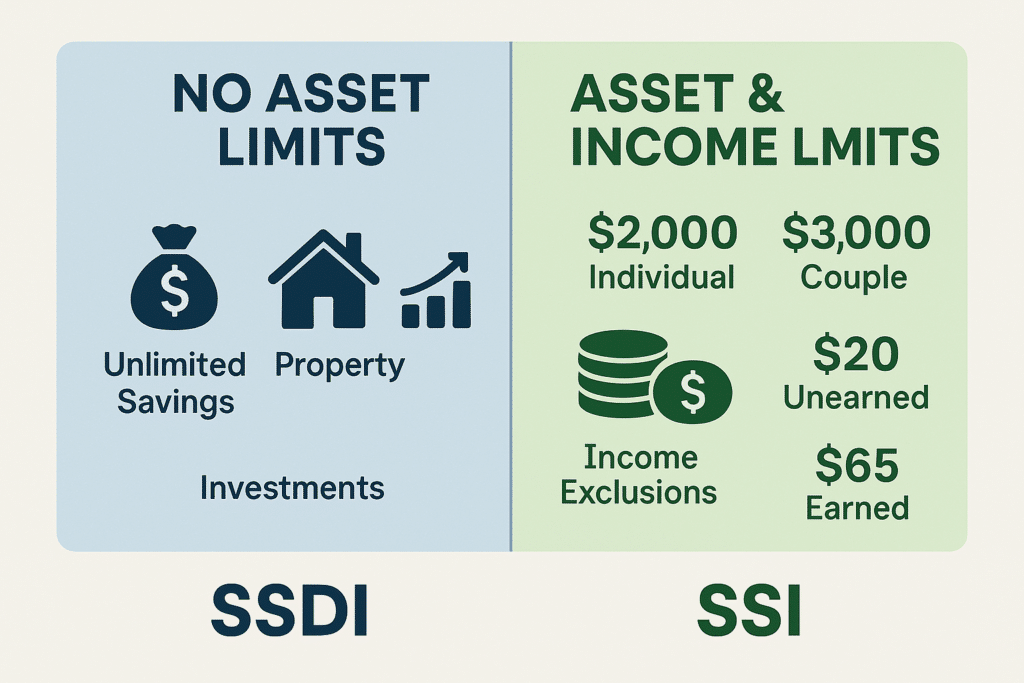
For Virginia residents receiving both SSDI and SSI benefits, careful financial planning is essential. SSDI benefits count as unearned income for SSI purposes, which can reduce or eliminate SSI payments if SSDI benefits exceed the SSI federal benefit rate.
Essential Resources for Virginia Disability Applicants
Understanding the complexities of SSDI vs SSI is just the beginning of your disability journey. Virginia residents can benefit significantly from additional resources that address specific aspects of the disability application and appeals process.
For those navigating the initial application process, our comprehensive guide provides invaluable insights into maximizing your chances of approval. 7 Essential Steps to Successfully Navigate the Initial SSD Application Process offers proven strategies that have helped thousands of Virginia residents secure their disability benefits on the first try.
This detailed resource covers everything from gathering the right medical documentation to understanding how the Social Security Administration evaluates your claim. The guide includes specific timelines, documentation checklists, and expert tips that can make the difference between approval and denial. Virginia residents who follow these proven steps significantly improve their chances of avoiding the lengthy appeals process and receiving benefits sooner.
Watch and Listen: Expand Your Understanding
SSDI vs SSI: Expert Insights for Virginia Residents
Dive deeper into the complexities of Social Security disability programs with our comprehensive audio discussion. This episode features experienced disability attorneys who break down the nuances of SSDI vs SSI eligibility, application strategies, and common mistakes that Virginia residents make when applying for benefits. Whether you’re commuting, exercising, or multitasking at home, this convenient audio format allows you to absorb crucial information about maximizing your disability benefits. Our experts share real-world examples and practical tips that can make the difference between approval and denial.
Navigating Virginia’s Disability Landscape: Advanced Strategies
This in-depth podcast explores advanced strategies for Virginia residents dealing with complex disability situations. Learn how to handle concurrent SSDI and SSI claims, understand the impact of state-specific factors on your benefits, and discover insider tips for working with the Social Security Administration. The discussion includes interviews with successful claimants who share their experiences and lessons learned throughout the process. Perfect for listening during your daily routine, this episode provides actionable insights that can significantly improve your disability claim outcomes.
Frequently Asked Questions
Can I apply for both SSDI and SSI at the same time?
Yes, Virginia residents can apply for both SSDI and SSI simultaneously if they potentially qualify for each program. This dual application approach ensures you don’t miss out on benefits due to eligibility uncertainties. If you qualify for both programs, you’ll receive the higher benefit amount, with SSI potentially supplementing lower SSDI payments.
How long does it take to get approved for SSDI vs SSI?
Both SSDI and SSI applications typically take 3-6
Frequently Asked Questions
- Can I qualify for both SSDI and SSI?
Yes, it is possible to qualify for both programs if you meet the eligibility criteria. This is known as “concurrent benefits.” For more information, visit the SSA’s concurrent benefits page.
- How do I apply for SSDI or SSI?
Applications can be completed online at ssa.gov, by calling the SSA, or by visiting your local Social Security office. Ensure you have all necessary documentation, including medical and financial records.
- What happens if my application is denied?
If your Social Security Disability (SSD) application is denied, you have the right to appeal the decision through the SSA’s structured appeals process. This involves several steps, including reconsideration, a hearing before an Administrative Law Judge, and potentially further appeals.
For detailed guidance on navigating a denied claim, read our blog: How to Handle a Denied SSD Claim. It provides essential tips and information to help you pursue the benefits you deserve.
- How long does it take to receive benefits?
Processing times vary. SSDI & SSI applications typically average about 9 months but can vary greatly from one claim to the another.
Navigating the Complexities of SSDI and SSI
The distinctions between SSDI and SSI are critical when determining the best program for your circumstances. However, the application process can be challenging, requiring precise documentation and strict adherence to guidelines.
At Harbison & Kavanagh, we understand the complexities of Social Security benefits. Our experienced attorneys are here to help you navigate the process and maximize your chances of approval. Visit our contact page or call us today at (804) 888-8000 for a free consultation.
Related Posts


