
Understanding how the Social Security Administration (SSA) evaluates medical conditions is the first step toward…
Disability Appeal Letter: 7 Proven Steps to Win Your SSDI/SSI Appeal (Virginia Guide)
Table of Contents
- Introduction
- Why a Disability Appeal Letter Matters
- When to Send Your Disability Appeal Letter
- 7-Step Checklist: How to Write a Disability Appeal Letter
- What to Include (and Avoid)
- Short Examples & Phrases You Can Borrow
- Evidence to Attach with Your Disability Appeal Letter
- Virginia & Surrounding States: Local Notes
- Helpful Links & Next Steps
- Watch and Listen: Expand Your Understanding
- FAQs
- Talk With Our Team
- More to Help You Succeed
Introduction
Disability appeal letter writers have one goal: change a “denied” into an approval. If you recently received an SSDI or SSI denial, a clear, well-structured letter can keep your claim alive, preserve your back pay, and point the Social Security Administration (SSA) to the exact evidence they missed. This guide walks you through creating a persuasive letter that works in Virginia and nearby states, with checklists, copy-and-paste phrasing, and visual tools you can save.
Because this article supports our appeals hub, you’ll also find natural links to step-by-step resources—like how to prove medical disability, what evidence to send, and how to prepare for a hearing. If you need a broader overview of benefits beyond appeals, visit our Social Security Disability overview for program basics and eligibility.
Why a Disability Appeal Letter Matters
A disability appeal letter is not a creative writing assignment—it’s a roadmap for the reviewer or judge. It:
- Preserves your filing date (and potential back pay) by formally contesting the decision.
- Explains exactly why the decision is wrong in plain language.
- Directs the reviewer to new or overlooked medical records.
- Clarifies work history issues, symptom severity, or RFC (Residual Functional Capacity) errors.
For many claimants, the right disability appeal letter improves outcomes at reconsideration and lays the groundwork for success at hearing if that becomes necessary.
When to Send Your Disability Appeal Letter
Title: Reconsideration vs. Hearing Timeline
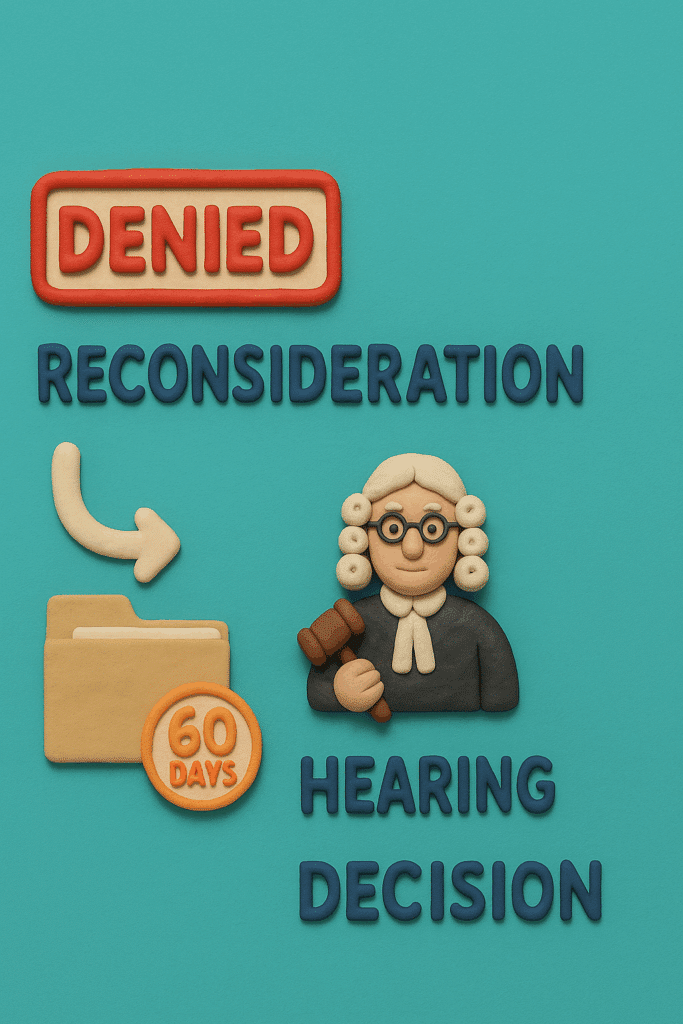
Summary: A left-to-right timeline compares key deadlines for reconsideration (file within 60 days; submit new evidence) and hearing (request within 60 days; submit evidence 5 business days before). This graphic helps you place your disability appeal letter at the right stage.
Timing is everything. Your letter accompanies your appeal forms and must be filed within the SSA deadline (generally 60 days from the date on your denial letter). If you’re requesting reconsideration or a hearing, submit the letter with your appeal packet so the reviewer sees your updated evidence immediately. You can find official forms and plain-English instructions on the SSA site: Appeal a Decision.
7-Step Checklist: How to Write a Disability Appeal Letter
Use this framework to draft a focused, persuasive letter in one sitting.
- Start with the basics. Include your name, SSN (last four), claim number, mailing address, phone, and the date. State that this is your disability appeal letter in response to the denial dated [insert date].
- Identify the denial reason(s). Quote the denial language (“not severe,” “can return to past work,” “insufficient evidence,” etc.). Your disability appeal letter should address each reason specifically.
- Tell your story through function. In a few sentences, connect symptoms to everyday limits: sitting, standing, lifting, using hands, concentrating, staying on task. This section of the disability appeal letter should be concrete (“I can sit 15 minutes before pain requires me to stand”).
- Point to the evidence. Cite new imaging, specialist notes, therapy records, medication changes, and side effects. In your disability appeal letter, list the documents by date and provider so the reviewer can find them quickly.
- Address treatment and compliance. If you paused treatment due to side effects, cost, or access, explain it. A well-explained context in the disability appeal letter prevents the reviewer from assuming non-compliance.
- Clarify work history and SGA. If SSA believed you could do other work, explain transferable skills limits, absenteeism risk, and off-task time. Use your disability appeal letter to correct earnings/SGA misunderstandings.
- Close with a clear request. Ask for a favorable decision or a hearing, and confirm you will submit any additional records promptly. Sign and date your disability appeal letter.
Title: SGA Reality Check
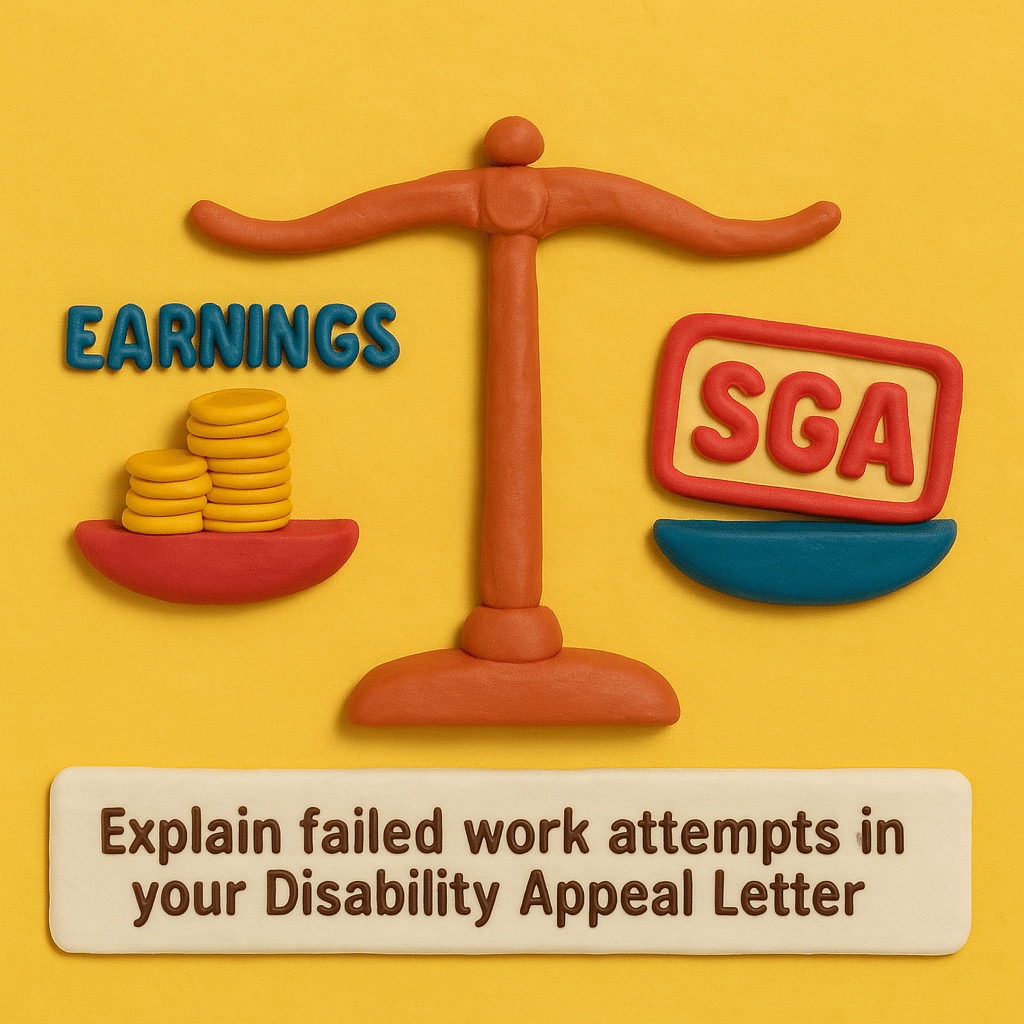
Summary: A quick diagram shows how earnings over the SGA threshold can sink a case, and why a failed work attempt should be explained inside the disability appeal letter.
What to Include (and Avoid)
Your disability appeal letter should be short (1–2 pages), specific, and easy to scan. Use headers and bullets. Avoid medical jargon—quote your doctors, not WebMD.
- Include: dates of services, provider names, test results, a 1–2 paragraph RFC narrative, medication list with side effects, and a concise request for review.
- Avoid: long life stories, generic statements (“I can’t work”), or blaming tone. The disability appeal letter is evidence-driven, not emotional.
Title: Function-to-Job Impact Chart

Summary: A two-column chart lists functional limits (sit, stand, lift, concentrate) and the job impact (off-task %, absences, need to recline). Use it to convert symptoms into work restrictions in your disability appeal letter.
Short Examples & Phrases You Can Borrow
Use these sentence starters to make your disability appeal letter move quickly:
- “This disability appeal letter responds to the denial dated 06/15/2025 (Exhibit A). The decision states I can perform light work; however, the enclosed MRI (05/22/2025) shows…”
- “My treating neurologist, Dr. Patel (04/10/2025), notes I must recline several times per day. This functional limitation is consistent with daily notes from physical therapy (March–May 2025) and supports this disability appeal letter.”
- “Earnings listed for 2025 reflect a failed work attempt of 10 days with accommodations; details are described in this disability appeal letter and supporting HR documentation.”
- “Medication changes documented 07/2025 created side effects (sedation, nausea) that increase off-task time beyond competitive employment; this disability appeal letter highlights those records and explains the treatment plan.”
Evidence to Attach with Your Disability Appeal Letter
Title: Evidence Map for Your File
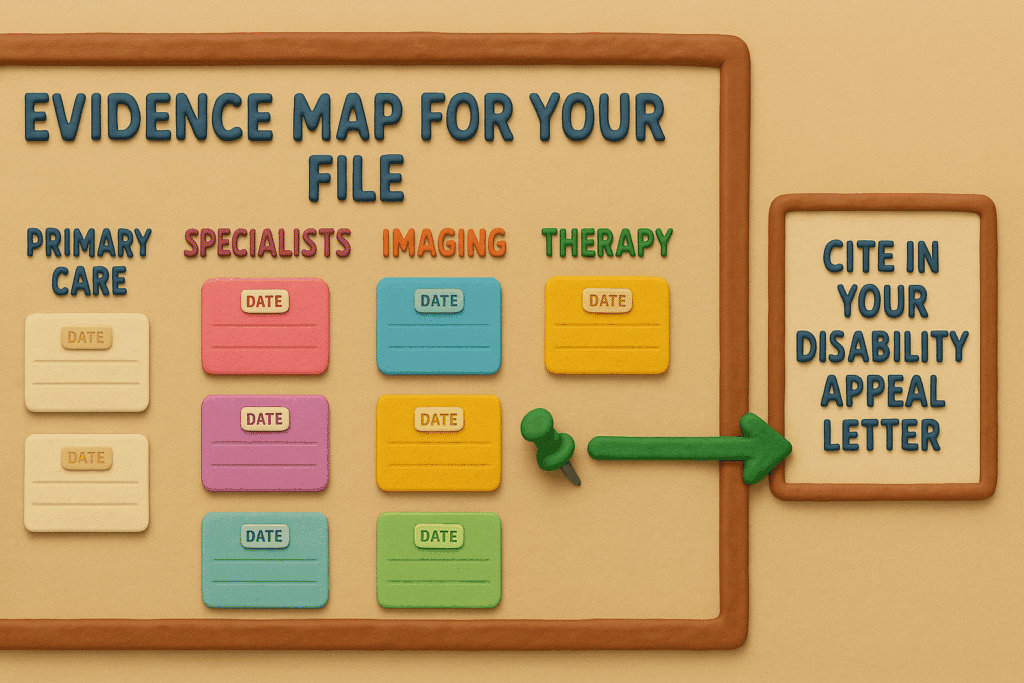
Summary: A simple map groups records by provider (primary care, specialist, imaging, therapy). Arrows point to where each item is cited in your disability appeal letter, so reviewers can find it fast.
Attach evidence that speaks directly to what the denial cited. Your letter should guide the reviewer to each document. Consider:
- Recent specialist notes (within the last 60–120 days)
- Objective tests (MRI, EMG, pulmonary function, neuropsych)
- Therapy notes (PT/OT/CBT) showing persistence despite treatment
- Medication lists with side effects and dose changes
- Functional capacity evaluations or treating source RFCs
- Third-party observations that corroborate daily limitations
To see how medical proof fits together, review Key Evidence for Your SSD Claim and Medical Records in SSD Appeals. Both posts complement the letter you’re writing.
Virginia & Surrounding States: Local Notes
SSA offices in Virginia, Maryland, North Carolina, and D.C. follow the same federal rules, but processing times and hearing formats (in-person, phone, video) vary. Your letter should request the format you can best handle and note any accommodation needs (e.g., language, mobility). If you live in a border community, explain care locations—even if your specialists are in another state, your letter should clarify why (specialty availability, insurance networks, etc.).
Need a refresher on programs and eligibility before you finalize your letter? Visit our Social Security Disability overview for a plain-English walkthrough of SSDI and SSI.
Helpful Links & Next Steps
- SSA’s official appeal portal: Appeal a Decision (file your disability appeal letter and forms online)
- Track your appeal: How to Check the Status of Your SSD Appeal
- Fix common mistakes: Denied SSD Claim? What to Do Next
- Improve strategy: 7 Powerful Strategies to Reverse a Denial
- Prepare for hearing: How to Prepare for Your SSD Hearing
- Understand the process: Social Security Disability Appeal Process
- External (SSA): Form SSA-561: Request for Reconsideration (PDF)
Watch and Listen: Expand Your Understanding
Podcast: Prefer audio? In this episode we break down—step by step—how to turn a denial into action with a focused disability appeal letter. Hear how judges read letters, why short is stronger than long, and what evidence summaries actually help. It’s perfect for listening while commuting or resting between appointments. By the end, you’ll know exactly what to include and what to skip.
FAQs
How long should a disability appeal letter be?
One to two pages. Your letter should be specific and evidence-driven, not a memoir.
Can I submit new evidence with my letter?
Yes. Your letter should list new records by date and provider and attach them. If more records are pending, say when they’ll arrive.
Do I need a lawyer to write my letter?
No, but many people get better results when an attorney aligns the letter with the medical and vocational evidence. We can help if you’d like guidance.
What if I missed the deadline?
Explain the reason and ask for good cause, then file immediately. Your letter should include the cause and any proof (hospitalization, mail issues, etc.).
Will a template work?
Use templates only as a starting point. Your letter must mirror your evidence and limitations to persuade a reviewer or judge.
Talk With Our Team
At Harbison & Kavanagh, we are dedicated to helping you navigate the SSDI application and appeals process. If you believe you qualify for SSDI and have questions, call us today at (804) 888-8000, or visit our contact page to schedule a free consultation. Our experienced lawyers are here to provide the support and guidance you need.
More to Help You Succeed
Don’t miss: Learn how to assemble the proof that makes your letter stick—read How to Prove Your Disability to the SSA for practical steps and examples.
Related Posts