Understanding how the Social Security Administration (SSA) evaluates medical conditions is the first step toward…
7 Crucial SSD vs SSI Work History Requirements Virginians Must Know (2025 Update)
Understanding the Financial & Work History Divide: SSD vs SSI Work History Requirements Explained
Table of Contents
- Introduction
- SSD vs. SSI at a Glance
- SSD vs SSI Work History Requirements: What Really Matters
- SSD Work Credits: How Many, How Fast, and by What Age?
- SSI Financial Rules: Income Limits vs. SSD and Asset Caps
- Earnings While Disabled: SGA, Trial Work Period & Safety Nets
- Virginia & Neighboring States: Practical Tips That Win Cases
- Choosing the Right Program: A Step-By-Step Decision Flow
- Watch and Listen: Expand Your Understanding
- More Helpful Reading
- Frequently Asked Questions
- We Can Help
Introduction
SSD vs SSI Work History Requirements—that exact phrase captures the number-one confusion we hear from clients across Virginia (and soon, our neighbors in North Carolina, Maryland, Washington, D.C., and West Virginia). Social Security Disability Insurance (SSDI) is earned insurance based on your taxes and work credits. Supplemental Security Income (SSI) is a need-based benefit tied to limited income and resources. If you clearly understand the work-credit test on the SSDI side and the income/resource test on the SSI side, you can avoid dead ends, speed up your claim, and protect retroactive benefits. This guide breaks down both tracks, highlights the latest 2025 numbers, and shows how to decide where you fit—so the SSD vs SSI Work History Requirements question never trips you up again.
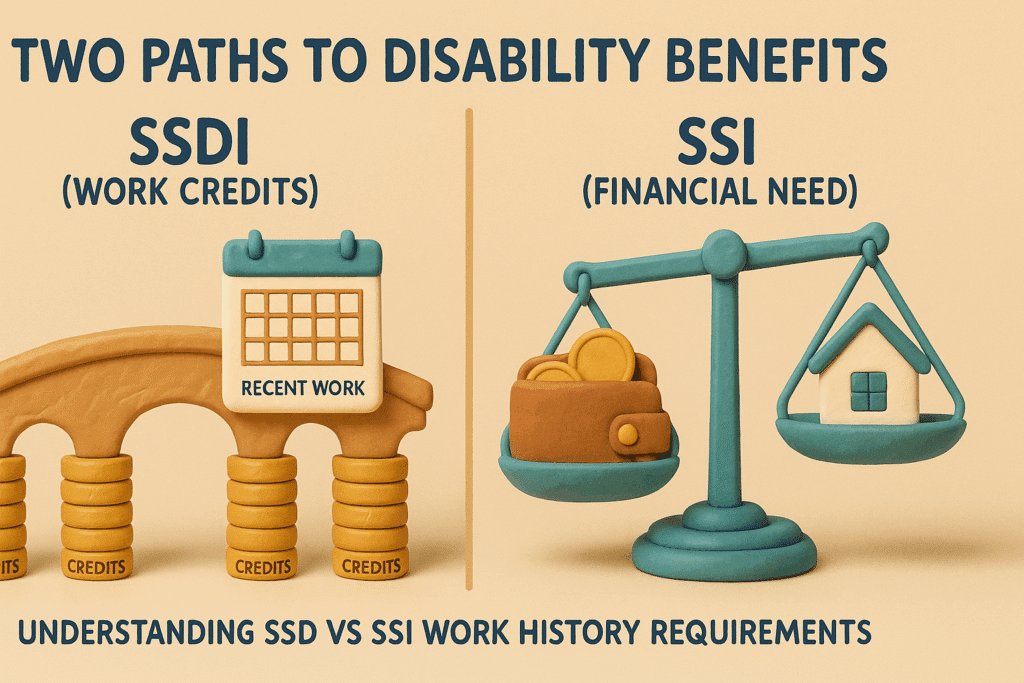
Two Paths to Disability Benefits—SSDI vs. SSI: This scene helps readers see why SSD vs SSI Work History Requirements lead to very different applications.
SSD vs. SSI at a Glance
Both programs are about disability, but their gatekeepers are different. SSDI asks, “Have you worked and paid enough into the system recently?” SSI asks, “Do you meet strict financial need rules?” When people ask about SSD vs SSI Work History Requirements, they’re really asking which gatekeeper they should satisfy first. Here’s the 30-second contrast:
- SSDI (Insurance-Based): Requires enough work credits (and recent work) at the time disability began. Benefit amount is tied to your past earnings.
- SSI (Needs-Based): Requires limited income and limited resources (assets). Payment is a federal base rate (plus any state supplement) reduced by your countable income.
For quick, official program rules, see SSA: Who qualifies for disability benefits? and SSA: Supplemental Security Income (SSI). You’ll see how SSD vs SSI Work History Requirements point your claim in one direction or the other.
SSD vs SSI Work History Requirements: What Really Matters
The phrase SSD vs SSI Work History Requirements bundles two different tests:
- SSDI’s Work Test: You must have earned enough work credits, and some of those credits must be recent when your disability began. Your age at onset determines how many credits you need.
- SSI’s Financial Test: There is no work-history requirement. Instead, you must fit within strict rules for income and resources (assets), and those amounts change your monthly benefit.
Clients often try to qualify for both. That’s smart because the SSD vs SSI Work History Requirements framework lets many people file a “concurrent” claim. SSDI can pay based on your earnings record; SSI can backstop you if your SSDI payment is very low or you lack sufficient credits.
SSD Work Credits: How Many, How Fast, and by What Age?
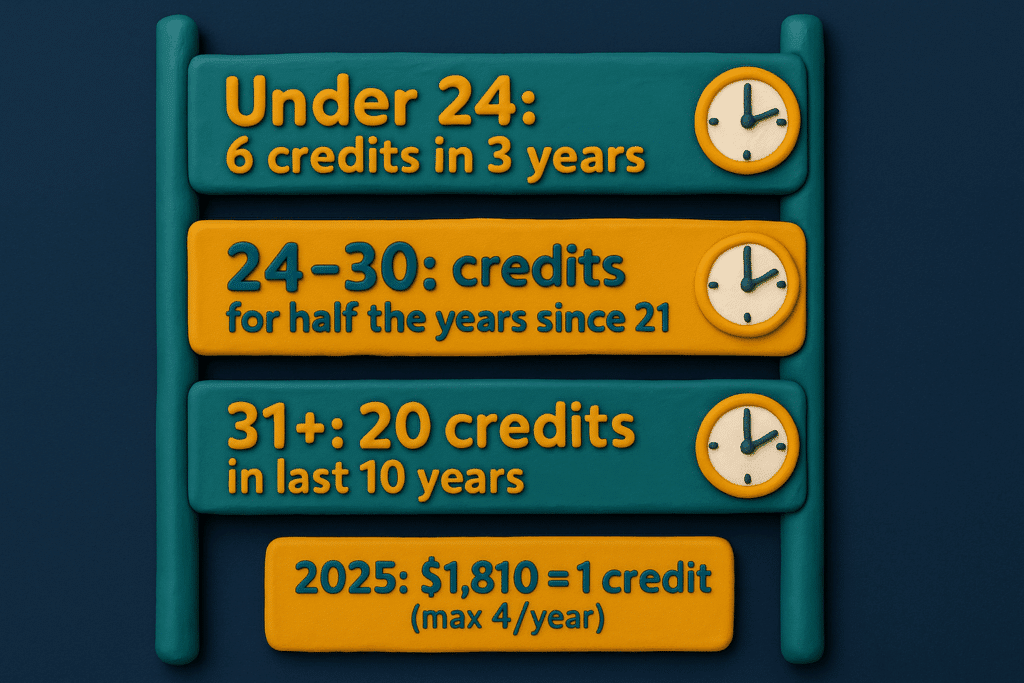
SSDI eligibility lives or dies on work credits. In 2025, you earn one credit for every $1,810 in covered wages or self-employment income, up to four credits per year. You don’t earn “partial” credits, and they’re earned by dollar amount—not calendar quarter. This is where SSD vs SSI Work History Requirements begin to diverge sharply.
How many credits do you need? It depends on your age when disability began:
- Before age 24: Generally 6 credits in the 3-year period ending when disability starts.
- Ages 24–30: Generally credits for half the time between age 21 and the onset of disability (for example, disability at age 27 ≈ 12 credits).
- Age 31 or older: Generally 20 credits in the 10 years just before disability began (the “recent work test”). Many people in their 40s–60s also meet a “duration of work” total that can approach 40 credits.
This age-based formula is why two people with similar medical issues can get different answers under SSD vs SSI Work History Requirements. If you’re short on credits or your credits aren’t recent enough, SSDI can be a hard stop; SSI might be your lifeline.
SSI Financial Rules: Income Limits vs. SSD and Asset Caps
SSI doesn’t ask about work credits. Instead, the SSI Income Limits vs SSD comparison is all about countable income and resources (assets). For 2025, the federal base rate (before reductions) is $967/month for an individual and $1,450/month for a couple. Many states add small supplements, but Virginia typically does not for most living situations; always check current rules in your locality.
Resources (assets): The general SSI cap is $2,000 for an individual and $3,000 for a couple. Some things don’t count—like your primary home, one vehicle used for transportation, household goods, certain burial funds, and up to $100,000 in an ABLE account. If you’re comparing SSI Income Limits vs SSD, remember SSDI doesn’t use a resource test at all; SSI does.
Income counting: SSI excludes the first $20 of most income, and then excludes the first $65 of earned income plus half of the remainder. Special rules help students (Student Earned Income Exclusion) and people with impairment-related work expenses. When someone asks about SSD vs SSI Work History Requirements, they’re often surprised to learn that on the SSI side, smart planning can legally reduce “countable income” and preserve monthly payments.
Helpful references: 2025 SSI federal payment amounts, resource rules, and earned-income exclusions.
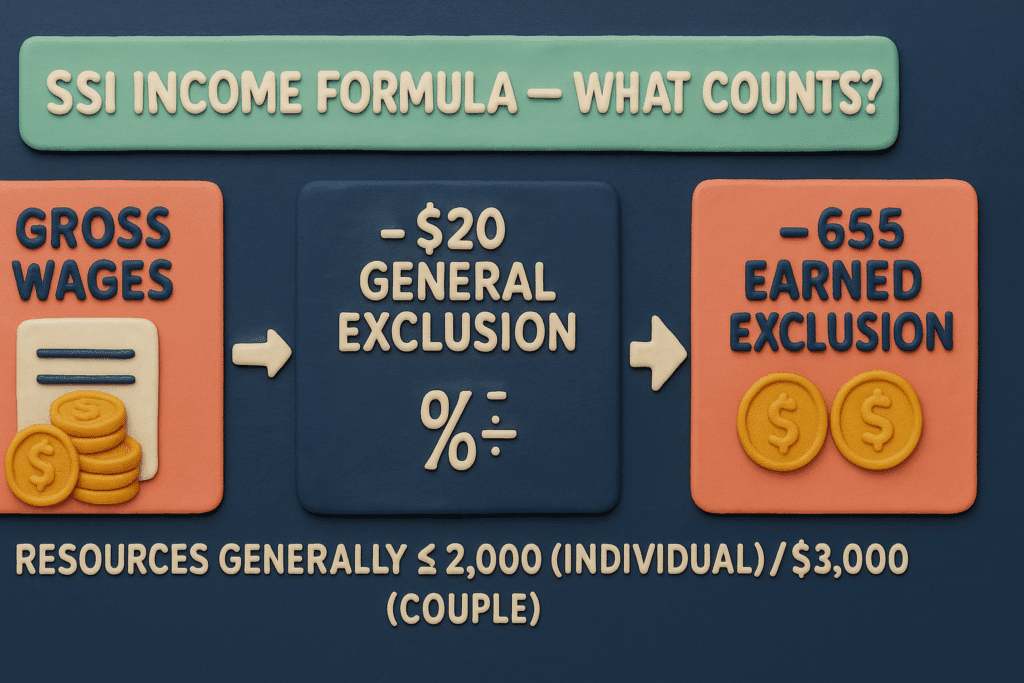
SSI Income Formula—What Counts? The panel reinforces how SSI Income Limits vs SSD can still allow part-time work without losing all SSI.
Earnings While Disabled: SGA, Trial Work Period & Safety Nets
If you’re applying or already on SSDI, two numbers dominate the conversation and influence how you assess SSD vs SSI Work History Requirements vs earnings:
- Substantial Gainful Activity (SGA) in 2025: $1,620/month (non-blind) and $2,700/month (statutorily blind).
- Trial Work Period (TWP) in 2025: Any month you earn at least $1,160 counts as a TWP month; you get nine TWP months (not necessarily consecutive) to test work without losing benefits.
After TWP, the Extended Period of Eligibility (EPE) offers additional protection—if your earnings dip below SGA, benefits can restart. This is where people juggling SSD vs SSI Work History Requirements need careful counsel: earnings that are safe on SSI might be risky on SSDI, and vice versa. Always report wages promptly to avoid overpayments.
Official references: SGA amounts and Trial Work Period rules.
Virginia & Neighboring States: Practical Tips That Win Cases
We serve clients throughout Virginia—from Richmond, Chesterfield, Henrico, Hanover, and the Tri-Cities to Hampton Roads and Northern Virginia—and increasingly in the Carolinas, Maryland, D.C., and West Virginia. No matter where you live in this region, SSD vs SSI Work History Requirements can tilt your strategy:
- Build the right record early. For SSDI, document past jobs and earnings thoroughly to prove the recent work test. For SSI, bring bank statements, titles, and proof that non-countable assets are exempt.
- Mind the dates. If you’re close to missing SSDI’s Date Last Insured, filing now can preserve your rights. If your assets are slightly over SSI limits, lawful spend-down or ABLE accounts may help.
- Think concurrent claims. If your credits are borderline, or your SSDI check would be small, a concurrent SSI claim can safeguard income while the case progresses.
- Report changes fast. New work, bank deposits, or gifts can affect SSI immediately. On SSDI, earnings around SGA/TWP thresholds should be reported to prevent surprises.
In short, whether you emphasize SSD vs SSI Work History Requirements or SSI Income Limits vs SSD, a local, detail-driven approach usually wins.
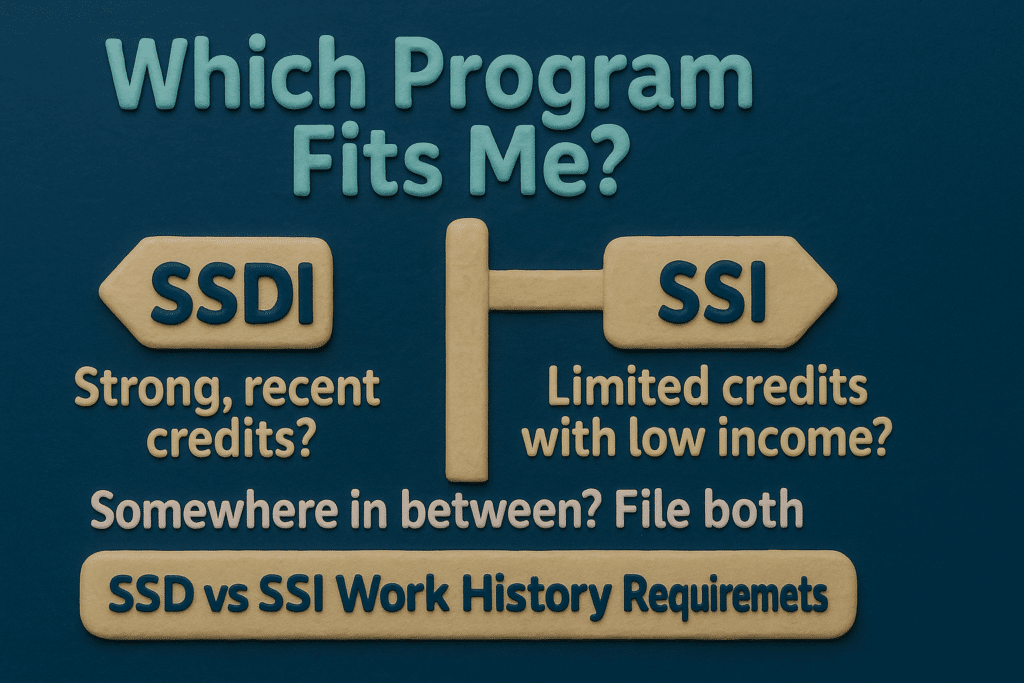
Choosing the Right Program: A Step-By-Step Decision Flow
Use this quick flow to apply the SSD vs SSI Work History Requirements test to your situation:
- Confirm your onset date. The age when your disability began drives your SSDI credit requirement.
- Count your credits. In 2025, each credit is earned at $1,810 of covered earnings (max four per year). Estimate whether you have recent credits.
- If credits are enough and recent: File SSDI. If your past earnings were modest, consider a concurrent SSI claim.
- If credits are short/out-of-date: Focus on SSI. Check resources ($2,000/$3,000 cap) and apply the income exclusions to project your payment.
- Already receiving benefits and trying to work? Know SGA and TWP thresholds. Keep paystubs and report promptly.
This structure turns SSD vs SSI Work History Requirements from a puzzle into a predictable checklist—and helps you avoid delays that can cost months of benefits.
Watch and Listen: Expand Your Understanding
Podcast: Prefer audio while commuting across I-64 or I-95? We unpack the same rules in plain English, with real-world examples from Virginia cases: when credits save an SSDI claim, when SSI’s financial filters apply, and how to secure medical evidence that complements the SSD vs SSI Work History Requirements analysis. Hear practical tips on documenting earnings, reporting changes, and timing your filing so you don’t miss your Date Last Insured.
Dig Deeper on Work History Strategy
Want a focused dive on how your job record influences the SSDI side of the equation? Read: The Impact of Work History on SSD. It’s a powerful complement to the SSD vs SSI Work History Requirements guide you’re reading now.
Frequently Asked Questions
Do I need recent work for SSDI?
Yes. For most people age 31+, you need at least 20 work credits in the 10 years before disability began. That “recent work test” is central to SSD vs SSI Work History Requirements.
How many credits can I earn in 2025?
In 2025, you earn one credit for each $1,810 in covered earnings, up to four credits for the year. This benchmark often decides the SSDI side of SSD vs SSI Work History Requirements.
What are SSI’s asset limits?
Generally $2,000 (individual) and $3,000 (couple), with major exclusions like your primary residence and one vehicle. This contrasts with SSDI, which has no asset test—another key split in SSD vs SSI Work History Requirements.
Can I work while getting benefits?
It depends. On SSDI, monthly earnings at or above SGA ($1,620 non-blind; $2,700 blind in 2025) can affect eligibility, although a Trial Work Period lets you test work. On SSI, earnings reduce payments but don’t necessarily eliminate them, thanks to exclusions. Understanding this helps you navigate SSI Income Limits vs SSD.
Should I file SSDI, SSI, or both?
If your credits are strong and recent, start with SSDI—and consider a concurrent SSI claim if the SSDI check will be small. If credits are weak or outdated, SSI may be the better immediate fit. That’s the practical heart of SSD vs SSI Work History Requirements.
Where can I read the official rules?
See SSA: 2025 work credit amounts, SGA thresholds, Trial Work Period, 2025 SSI base rates, and resource rules. These anchors keep your SSD vs SSI Work History Requirements planning on solid ground.
We Can Help
At Harbison & Kavanagh, we are dedicated to helping you navigate the SSDI application and appeals process. If you believe you qualify for SSDI and have questions, call us today at (804) 888-8000, or visit our contact page to schedule a free consultation. Our experienced lawyers are here to provide the support and guidance you need.
Related Posts