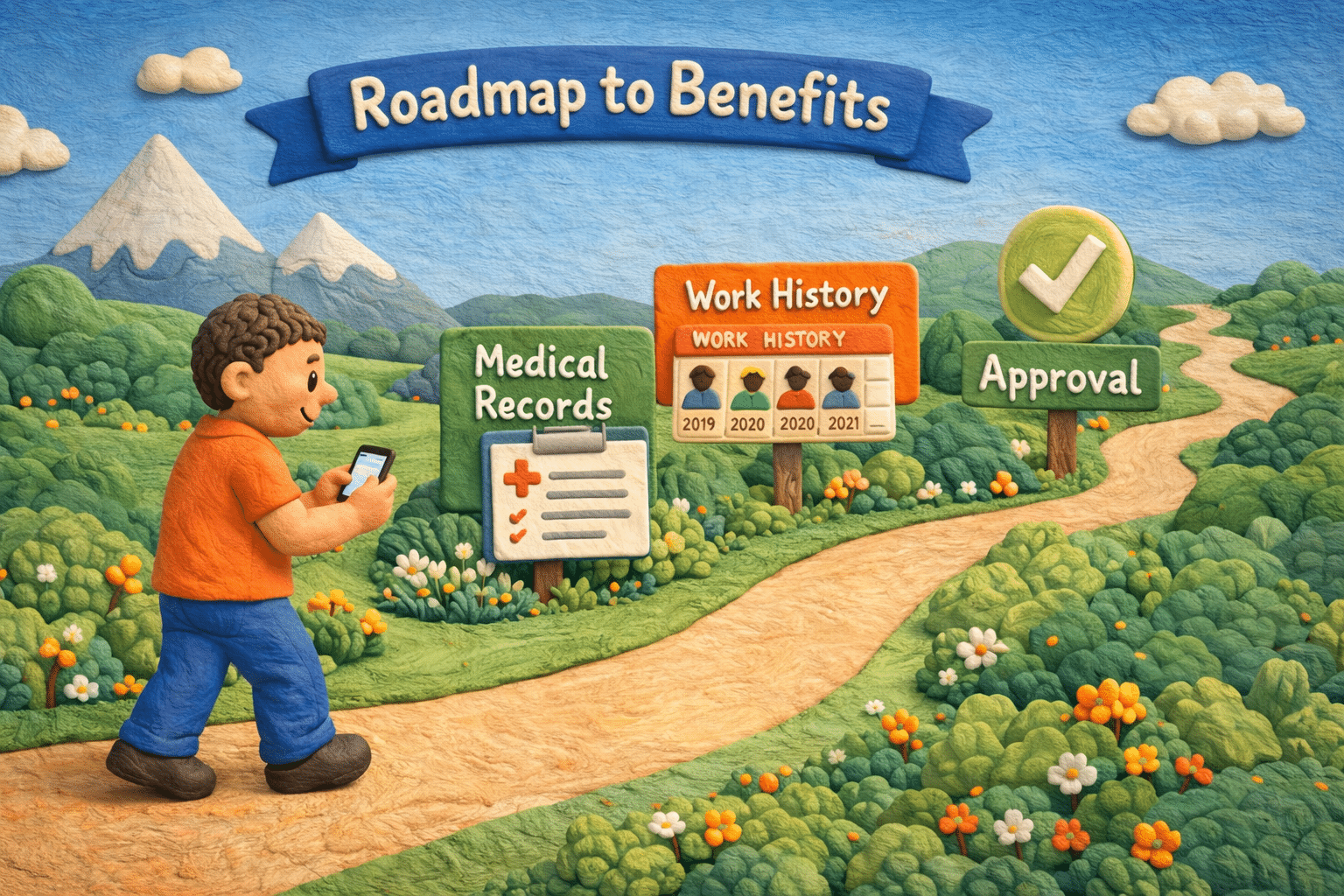
Understanding how the Social Security Administration (SSA) evaluates medical conditions is the first step toward…
Unlock 7 Powerful Steps to Qualifying for SSDI with Bipolar Disorder in Virginia – Overcome Challenges Today!
As part of our comprehensive resources on qualifying disabilities, we’re diving deep into qualifying for SSDI with bipolar disorder in Virginia. If you’re struggling with the unpredictable swings of bipolar disorder, you’re not alone. This condition can profoundly impact your ability to maintain steady employment. Social Security Disability Insurance (SSDI) can be a vital lifeline. Understanding the nuances of SSDI claims is crucial for success. This guide will equip you with essential knowledge on managing episodes, gathering evidence, and navigating the application process to boost your chances of approval.
- Introduction
- Understanding Bipolar Disorder and SSDI Eligibility
- Qualifying for SSDI with Bipolar Disorder in Virginia: Key Criteria
- Managing Bipolar Episodes to Strengthen Your SSDI Claim
- Evidence Requirements for SSDI Bipolar Disorder Claims
- Step-by-Step SSDI Application Guide for Virginia Residents
- Common Challenges and How to Overcome Them
- SSDI Considerations in Surrounding States
- Watch and Listen: Expand Your Understanding
- Dive Deeper into Mental Health SSDI Claims
- Frequently Asked Questions
Introduction
Qualifying for SSDI with bipolar disorder in Virginia can feel overwhelming. However, with the right information, you can navigate this process confidently. Bipolar disorder is a mental health condition characterized by extreme mood swings from manic highs to depressive lows. It affects millions of Americans. Accessing SSDI benefits requires proving that your condition severely limits your ability to work. According to the Social Security Administration (SSA), mental disorders like bipolar are evaluated under specific listings. Success hinges on detailed documentation.
This article explores managing episodes effectively, meeting evidence standards, and following a clear application path to help you secure the benefits you deserve.
Bipolar disorder isn’t just about mood changes; it can disrupt daily life, relationships, and employment. Symptoms during manic phases might include racing thoughts, reduced need for sleep, and impulsive behaviors. Depressive episodes bring overwhelming sadness, fatigue, and loss of interest in activities.
For SSDI eligibility, your condition must last at least 12 months and prevent substantial gainful activity (SGA), currently defined as earning over $1,550 per month for non-blind individuals in 2024. In Virginia, local SSA offices process claims, but appeals often involve hearings in Richmond or other regional centers.
Understanding the implications of these symptoms is key. It’s critical to document how your episodes affect your daily life, including your ability to perform work functions. This documentation will be essential for your SSDI claim.
To qualify, you also need sufficient work credits—typically 40 credits, with 20 earned in the last 10 years. Younger applicants may need fewer. If bipolar disorder has forced you out of work, SSDI provides monthly payments averaging $1,500, plus Medicare after two years. But approval rates hover around 37% initially, making preparation key. Let’s break down how to build a strong case.
Understanding Bipolar Disorder and SSDI Eligibility
Bipolar disorder comes in types: Bipolar I with severe manic episodes, Bipolar II with hypomania and major depression, and cyclothymic disorder with milder swings. The SSA recognizes it under Listing 12.04 in the Blue Book, which covers depressive, bipolar, and related disorders. To meet this listing, you must satisfy Paragraph A (symptoms) and either B (functional limitations) or C (serious and persistent condition).
For Paragraph A in bipolar, you need at least three symptoms like pressured speech, flight of ideas, inflated self-esteem, decreased sleep need, distractibility, risky activities, or increased goal-directed activity. Paragraph B requires extreme limitation in one or marked in two areas: understanding information, interacting with others, concentrating, or adapting oneself. Paragraph C demands a two-year history with ongoing treatment and minimal capacity to adapt to changes.
In Virginia, where mental health resources vary by region—from urban Richmond to rural Appalachia—accessing consistent care is vital. Surrounding states like Maryland and North Carolina have similar SSA processes, but wait times can differ; Virginia’s average initial decision takes about 7 months. If you don’t meet the listing, the SSA assesses your residual functional capacity (RFC) to see if you can perform past or any work.
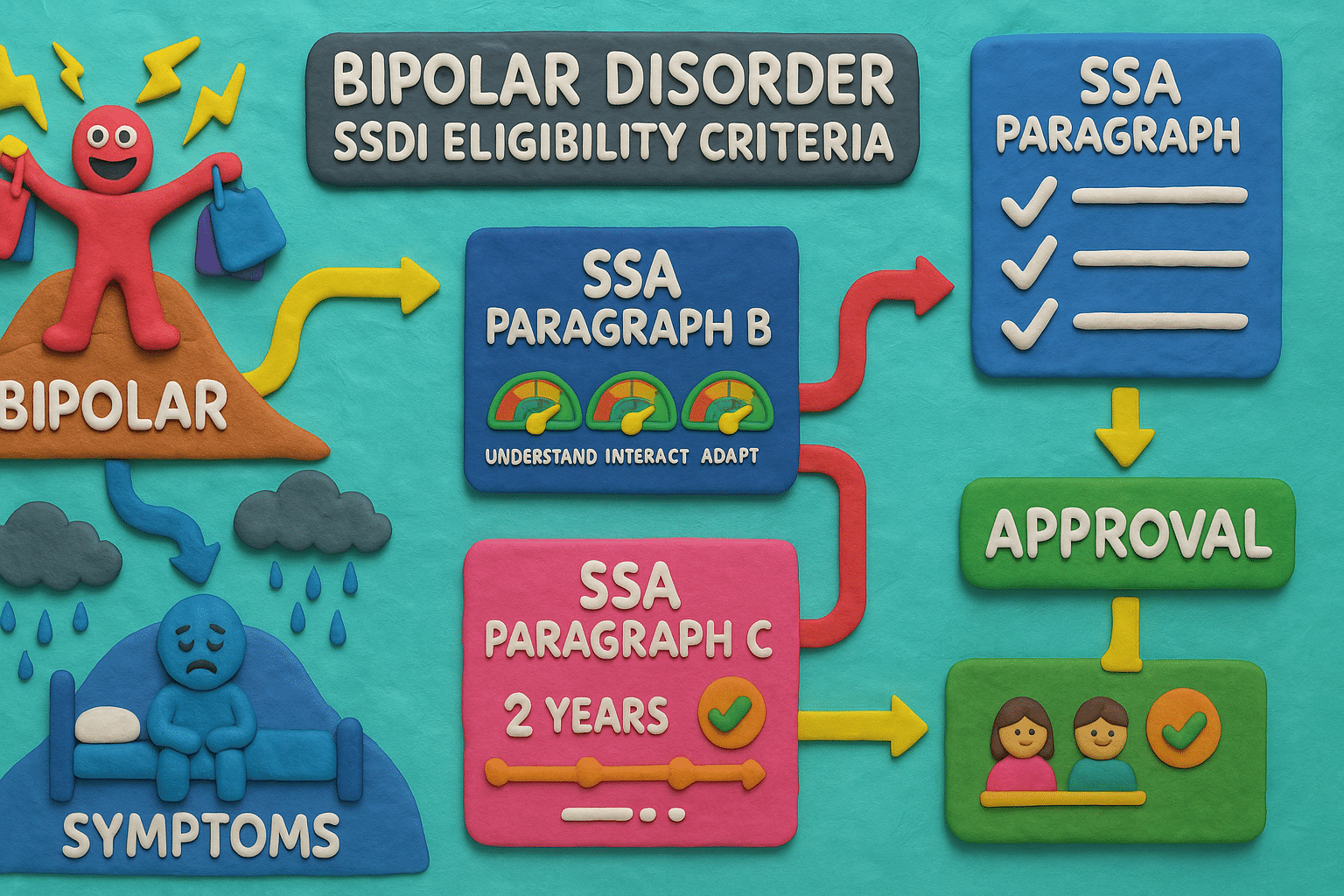
Qualifying for SSDI with bipolar disorder in Virginia often involves proving these elements through medical records. External resources like the SSA Blue Book Listing 12.04 provide detailed criteria.
Qualifying for SSDI with Bipolar Disorder in Virginia: Key Criteria
Qualifying for SSDI with bipolar disorder in Virginia starts with meeting the SSA’s definition of disability: a condition preventing SGA for at least 12 months. For bipolar, this means documenting how episodes impair work functions.
But with bipolar, even sedentary work can be impossible due to concentration issues.
For those under 50, the SSA is stricter, assuming adaptability to lighter jobs.
Work history matters—ensure you’ve paid into Social Security via FICA taxes.
The state has Disability Determination Services (DDS) in Richmond, Roanoke, and Norfolk, where examiners review claims. If denied, reconsideration follows, then a hearing before an Administrative Law Judge (ALJ), where approval jumps to 50%.
Virginia-specific factors include higher denial rates for mental claims (around 65% initially), so detailed RFC forms from psychiatrists are crucial.
In manic states, poor judgment might lead to workplace conflicts; in depression, absenteeism skyrockets.
Virginia-specific factors include higher denial rates for mental claims (around 65% initially), so detailed RFC forms from psychiatrists are crucial. The state has Disability Determination Services (DDS) in Richmond, Roanoke, and Norfolk, where examiners review claims. If denied, reconsideration follows, then a hearing before an Administrative Law Judge (ALJ), where approval jumps to 50%.
Work history matters—ensure you’ve paid into Social Security via FICA taxes. For those under 50, the SSA is stricter, assuming adaptability to lighter jobs. But with bipolar, even sedentary work can be impossible due to concentration issues.
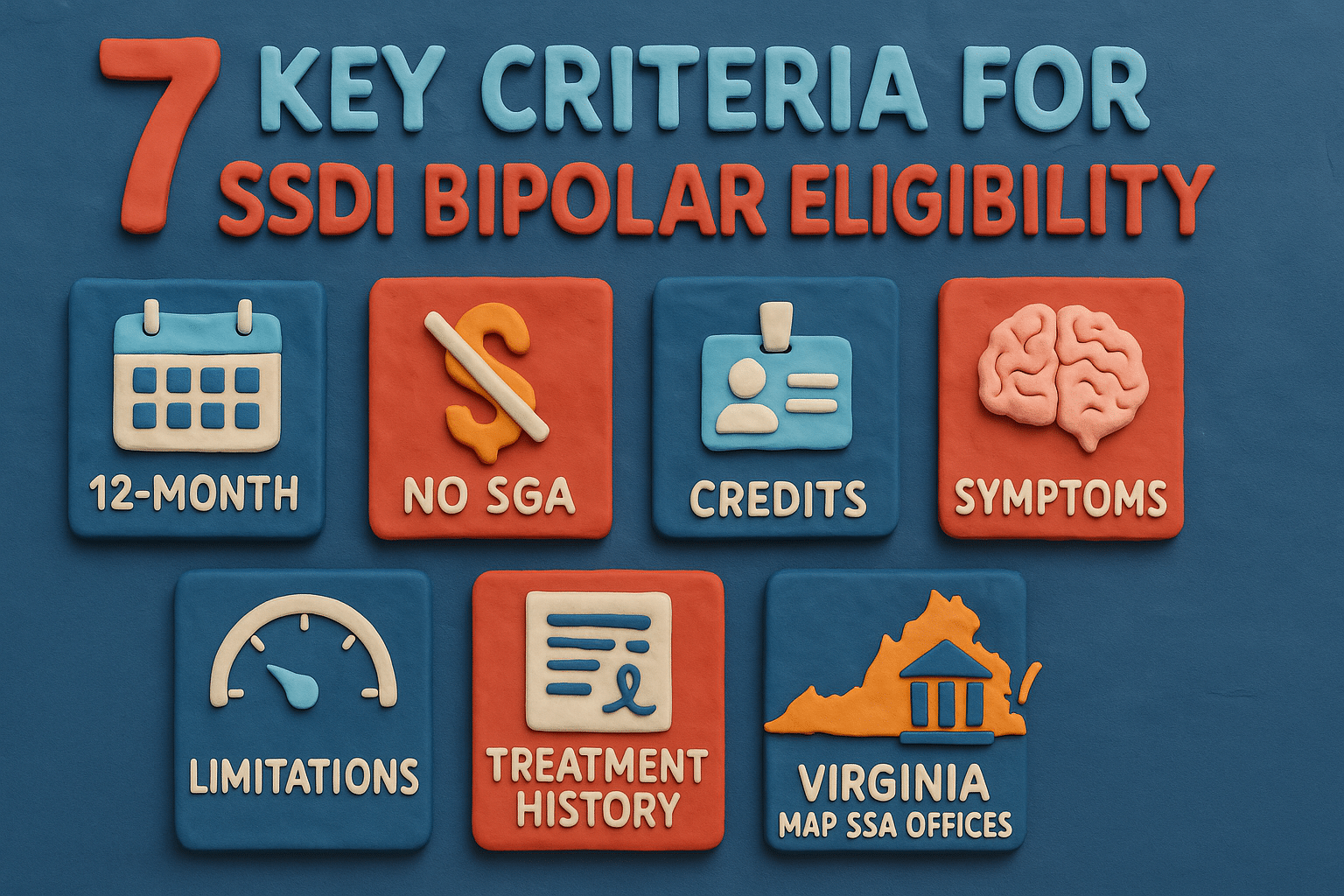
Remember, qualifying for SSDI with bipolar disorder in Virginia requires aligning your case with these criteria meticulously.
Managing Bipolar Episodes to Strengthen Your SSDI Claim
Managing bipolar episodes is pivotal when qualifying for SSDI with bipolar disorder in Virginia. Consistent treatment demonstrates the condition’s severity while showing compliance, which SSA favors.
Strategies include medication (mood stabilizers like lithium), therapy (cognitive behavioral therapy), and lifestyle adjustments like sleep routines and stress management.
Document how episodes affect work: Track manic periods leading to overspending or conflicts, and depressive ones causing missed days. Use journals or apps to log symptoms, shared with doctors for RFC assessments. In Virginia, resources like community mental health centers in Fairfax or Charlottesville provide support.
For claims, show that despite management, episodes persist, limiting function. If episodes require hospitalization, include records. Surrounding states like West Virginia offer similar Medicaid-funded therapies, aiding cross-border residents.
Effective management not only improves life but bolsters your case for qualifying for SSDI with bipolar disorder in Virginia.
Gathering robust evidence is essential for qualifying for SSDI with bipolar disorder in Virginia. The SSA requires objective medical evidence from acceptable sources like psychiatrists or psychologists.
Key documents include diagnosis confirmation, treatment history, hospitalization records, and psychological testing. Proper documentation not only supports your claim but also illustrates the severity of your condition.
Gathering robust evidence is essential for qualifying for SSDI with bipolar disorder in Virginia. The SSA requires objective medical evidence from acceptable sources like psychiatrists or psychologists. Key documents include diagnosis confirmation, treatment history, hospitalization records, and psychological testing.
For Listing 12.04, provide symptom documentation via progress notes and mental status exams. RFC forms should detail limitations, e.g., “marked inability to concentrate for extended periods.” Non-medical evidence like employer statements on absenteeism helps.
In Virginia, obtain records from providers promptly, as delays extend processing. Include lab results if medications cause side effects like fatigue, further impairing work.
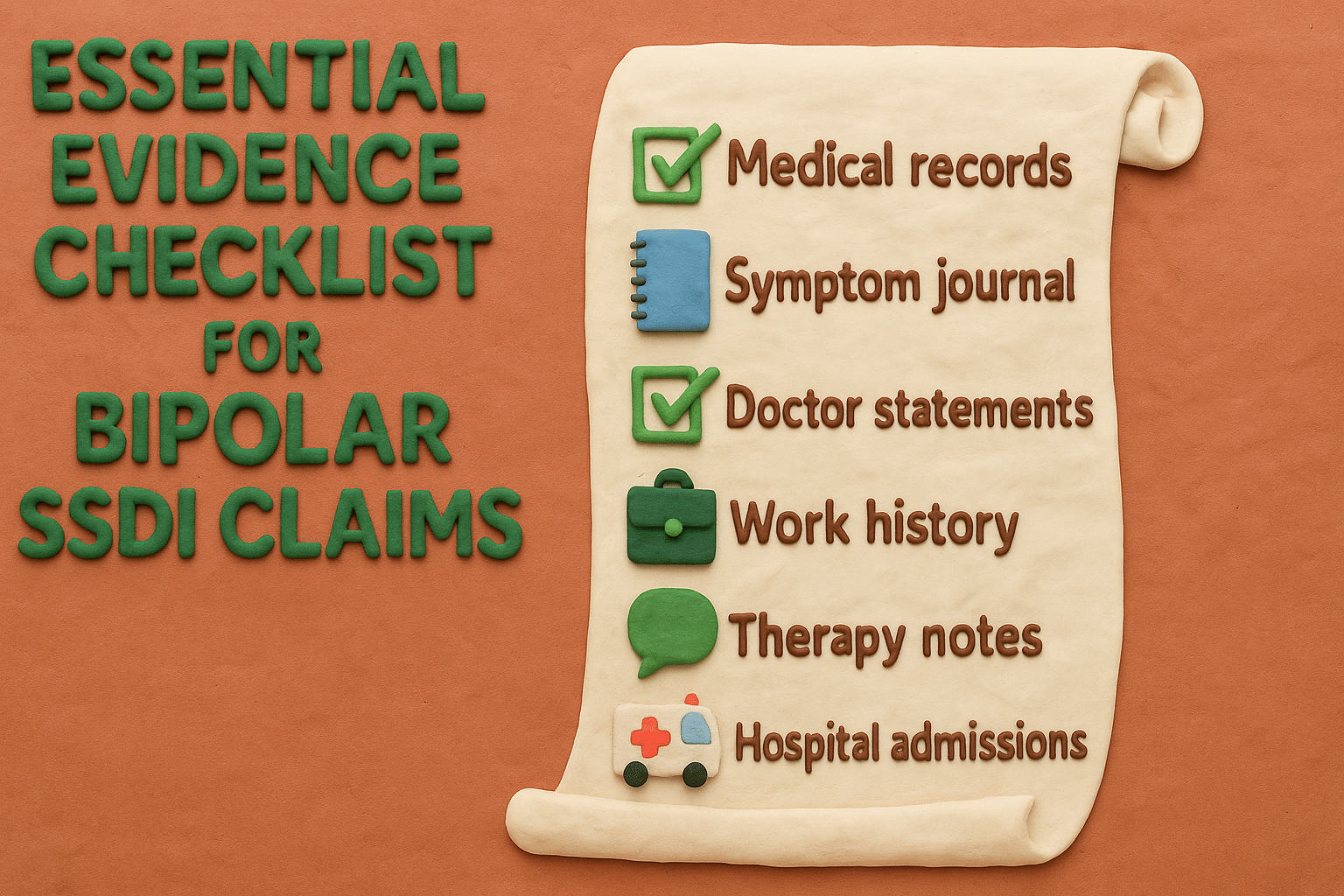
Strong evidence can make or break your claim when qualifying for SSDI with bipolar disorder in Virginia.
Step-by-Step SSDI Application Guide for Virginia Residents
Follow these 7 powerful steps to apply when qualifying for SSDI with bipolar disorder in Virginia:
- Assess Eligibility: Confirm work credits and disability duration.
- Gather Documents: Collect medical records, work history, and personal info.
- Apply Online or In-Person: Use SSA.gov or visit a Virginia SSA office.
- Complete Forms: Detail symptoms and limitations accurately.
- Submit and Wait: Expect 3-5 months for initial decision.
- Reconsider if Denied: Appeal within 60 days.
- Prepare for Hearing: Present evidence before ALJ.
Virginia applicants can apply via phone at 1-800-772-1213. For bipolar disorder claims, emphasize your mental residual functional capacity.
Common Challenges and How to Overcome Them
Denials often stem from insufficient evidence or non-compliance. Overcome by consulting attorneys experienced in Virginia claims. Stigma around mental health can deter, but professional support helps.
SSDI Considerations in Surrounding States
In Maryland, faster processing; West Virginia has rural access issues. Rules are federal, but local offices vary.
Watch and Listen: Expand Your Understanding
Struggling with the debilitating cycles of bipolar disorder can make navigating SSDI feel impossible, but visual insights can clarify the path forward. Our video breaks down the eligibility criteria with real-life examples, demonstrating how episodes impact work and what evidence truly matters. You’ll see animated scenarios of managing symptoms and application tips tailored for Virginia residents, offering unique strategies not found in text alone. Gain confidence through expert explanations that make complex SSA rules accessible. Don’t just read about it—watch now to visualize your successful claim.
In today’s fast-paced world, absorbing information on the go is essential, especially when dealing with bipolar disorder’s demands. Our podcast delivers in-depth discussions with mental health experts and SSDI attorneys, sharing insider tips on evidence gathering and episode management. Listen while commuting or relaxing, multitasking without missing key insights on Virginia-specific applications. Hear personal stories from claimants who’ve won benefits, plus advice on surrounding states. This audio format provides the flexibility you need—tune in to empower your journey toward SSDI approval.
Dive Deeper into Mental Health SSDI Claims
Building on our exploration of bipolar disorder, if depression co-occurs or you’re seeking more on mental health claims, explore this insightful resource. It offers proven strategies to enhance your understanding and strengthen related applications.
Unlock 7 Essential Strategies for Qualifying for SSDI with Depression
Frequently Asked Questions
What are the main symptoms needed to qualify for SSDI with bipolar disorder?
To meet SSA criteria, you need at least three symptoms like pressured speech, decreased need for sleep, or distractibility, plus functional limitations.
How long must bipolar disorder last to be eligible for SSDI?
The condition must be expected to last at least 12 months or result in death, with a two-year history for Paragraph C.
What evidence is most important for a bipolar SSDI claim in Virginia?
Medical records, doctor statements, treatment history, and symptom journals are crucial to prove severity and work limitations.
Can I work part-time while applying for SSDI with bipolar disorder?
Yes, if earnings are below SGA levels ($1,550/month in 2024), but it must not contradict your claim of inability to work full-time.
How does the SSDI appeal process work in Virginia?
After denial, request reconsideration within 60 days, then a hearing if needed, where an ALJ reviews your case.
At Harbison & Kavanagh, we are dedicated to helping you navigate the SSDI application and appeals process. If you believe you qualify for SSDI and have questions, call us today at (804) 888-8000, or visit our contact page to schedule a free consultation. Our experienced lawyers are here to provide the support and guidance you need to help with qualifying for ssdi with bipolar disorder.
Remember, when navigating SSDI claims, this resource can be pivotal in your journey to securing the benefits you deserve.
Related Posts