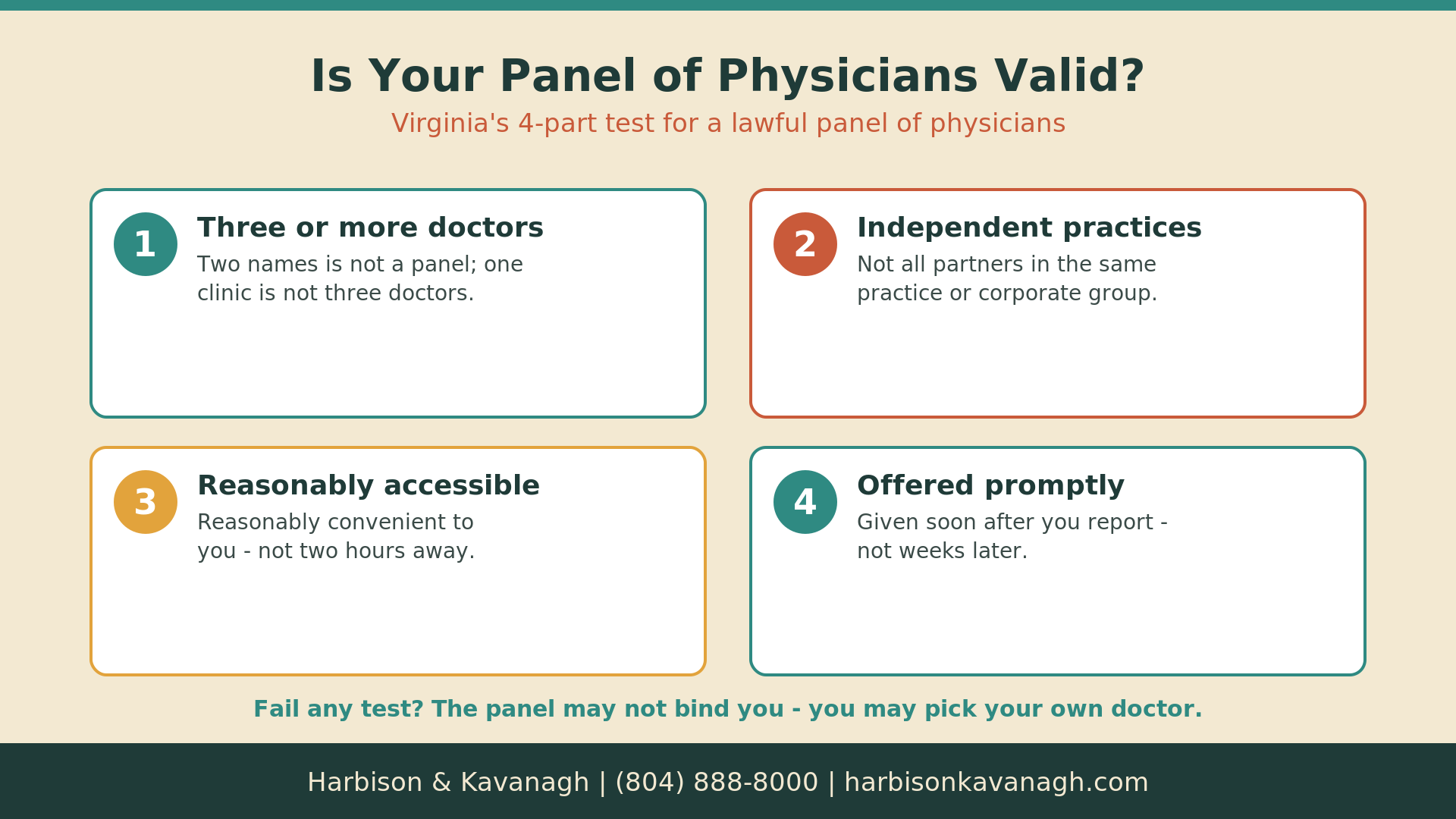
TL;DR — Key Takeaways You choose — but from a list. Virginia is a "panel…
How Much Does Workers Comp Pay in Virginia? Your 2026 Benefit Rates, Explained
The first question after a workplace injury is almost always about money. If you cannot work, how much of your paycheck does workers’ compensation actually replace – and for how long?
The answer in Virginia comes down to one number: your average weekly wage. Nearly every wage benefit in the system is calculated from it. This guide explains exactly how much does workers comp pay in Virginia in 2026, how the math works, when the checks start, and what happens when an injury is permanent.
TL;DR – KEY TAKEAWAYS
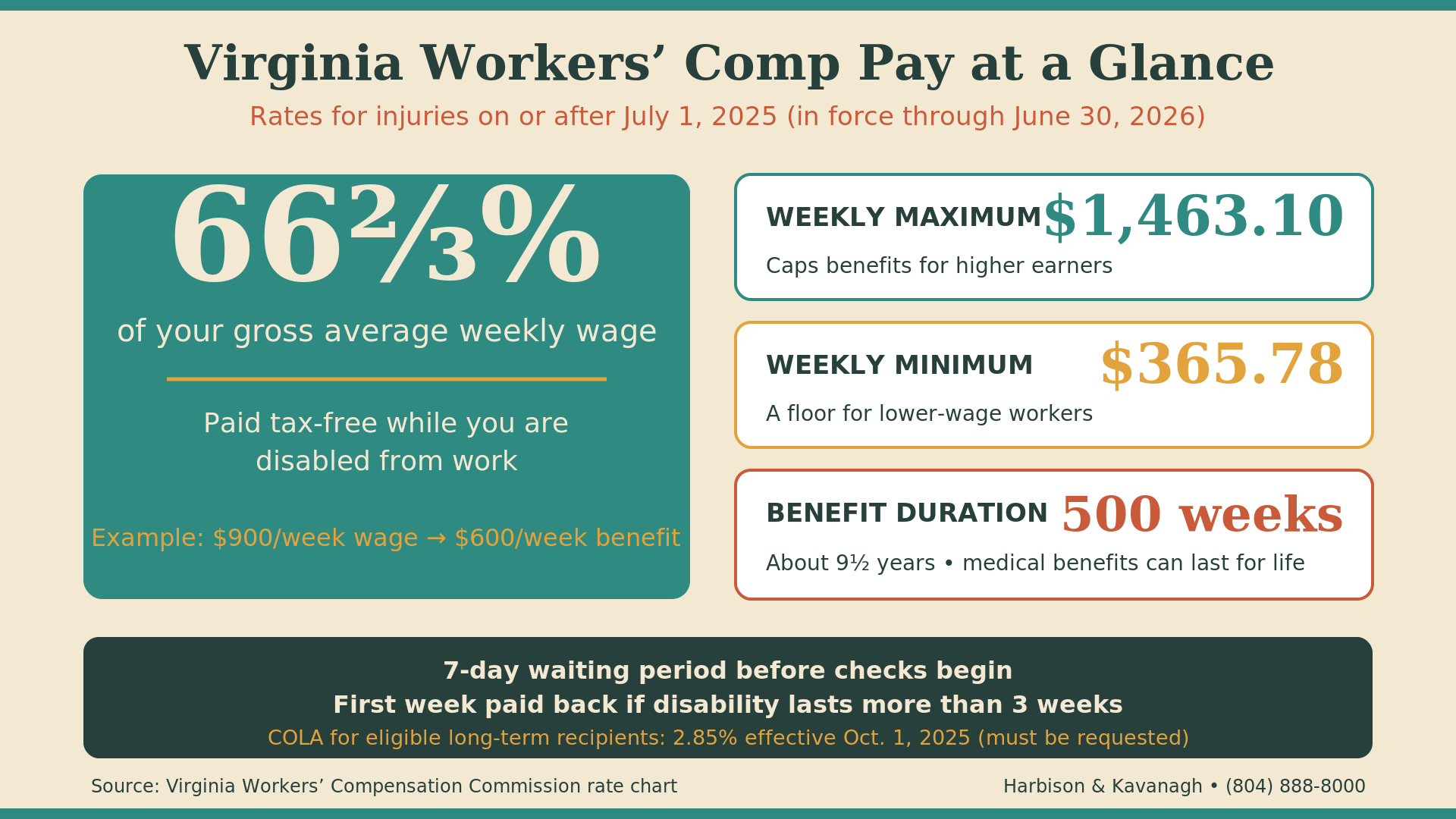
- – The basic formula is two-thirds. Virginia wage-loss benefits pay 66 2/3 percent of your gross average weekly wage, tax-free, while you are disabled from work.
- – There is a cap and a floor. For injuries on or after July 1, 2025, the weekly maximum is $1,463.10 and the weekly minimum is $365.78, set each year by the Virginia Workers’ Compensation Commission.
- – Checks do not start on day one. Virginia has a seven-day waiting period; those first days are paid back only if your disability lasts more than three weeks.
- – Wage benefits can last up to 500 weeks – roughly nine and a half years and longer in catastrophic cases. Medical benefits for the injury can last for life.
- – Your average weekly wage is where claims are won or lost. If overtime or a second job is left out of the calculation, every check you receive will be too small.
TABLE OF CONTENTS
- – How Much Does Workers’ Comp Pay in Virginia? The Two-Thirds Rule
- – How Is Your Average Weekly Wage Calculated?
- – What Are the Maximum and Minimum Weekly Rates for 2026?
- – When Do Workers’ Comp Checks Start in Virginia?
- – What Is the Difference Between Total and Partial Wage Benefits?
- – How Are Permanent Injuries Paid?
- – How Long Do Workers’ Comp Benefits Last in Virginia?
- – What Does Workers’ Comp Cover Beyond the Weekly Check?
- – An Attorney’s Point of View: The Wage Number Everyone Gets Wrong
- – Watch and Learn
- – Frequently Asked Questions
HOW MUCH DOES WORKERS’ COMP PAY IN VIRGINIA? THE TWO-THIRDS RULE
Virginia wage-loss benefits replace two-thirds (66 2/3 percent) of your gross average weekly wage, up to the state maximum. The payments are not taxed, which softens the gap between two-thirds of gross pay and your normal take-home check.
Here is the basic math. A worker earning $900 a week before a warehouse injury receives $600 a week in temporary total disability benefits. A worker earning $1,500 a week receives $1,000.
So when clients ask how much does workers comp pay in Virginia, the honest answer is: two-thirds of whatever the insurer says your average weekly wage is. That last part matters, because the insurer calculates the number first – and the calculation is not always right.
HOW IS YOUR AVERAGE WEEKLY WAGE CALCULATED?
Your average weekly wage (AWW) is generally your gross earnings – before taxes – in the 52 weeks before the injury, divided by 52. If you worked less than a year, the period you actually worked is used, or the earnings of a similar employee in the same job.
Three details routinely change the number, and all three favor the worker when handled correctly.
Overtime counts. The calculation uses your real gross earnings, not your base hourly rate. A $20-per-hour employee who regularly worked overtime may have a true AWW hundreds of dollars higher than 40 hours of straight time.
A second job can count. If you held two similar jobs and the injury knocks you out of both, Virginia law can combine the wages from both employments in the calculation.
The wage statement is evidence, not gospel. Insurers prepare a wage chart from employer payroll records. Missing weeks, bonuses, or a second employment all shrink the number – and every benefit that follows shrinks with it.
WHAT ARE THE MAXIMUM AND MINIMUM WEEKLY RATES FOR 2026?
Every July 1, the Virginia Workers’ Compensation Commission sets a new maximum and minimum weekly compensation rate tied to the statewide average wage. For injuries occurring on or after July 1, 2025 (the rates in force until July 1, 2026):
– Maximum weekly benefit: $1,463.10. High earners hit this cap – two-thirds of any AWW above roughly $2,195 is capped here.
– Minimum weekly benefit: $365.78. Lower-wage workers are lifted to this floor (but never above their actual AWW).
– Cost-of-living adjustment: 2.85 percent, effective October 1, 2025, for eligible long-term total-disability and death-benefit recipients. COLA is generally not automatic in Virginia – it must be requested.
You can verify the current figures on the Commission’s official rate chart: Rates (Min-Max Benefits, COLA, Mileage) — Virginia Workers’ Compensation Commission
Virginia Workers’ Comp Pay at a Glance (2025-2026)
WHEN DO WORKERS’ COMP CHECKS START IN VIRGINIA?
Virginia has a seven-day waiting period. No wage benefits are owed for the first seven calendar days you are out of work. If your disability continues past seven days, checks begin with day eight.
There is a catch-up rule that surprises people in a good way: if your disability lasts more than three weeks, the insurer must go back and pay you for that first week too.
Two practical points. First, benefits are not owed until your claim is accepted or awarded – report the injury to your employer within 30 days and file a claim with the Commission within two years, or the question of how much you are owed becomes moot. Second, an “accepted” claim is only secure once the Commission enters an award order. A voluntary check without an award protects the insurer, not you.
WHAT IS THE DIFFERENCE BETWEEN TOTAL AND PARTIAL WAGE BENEFITS?
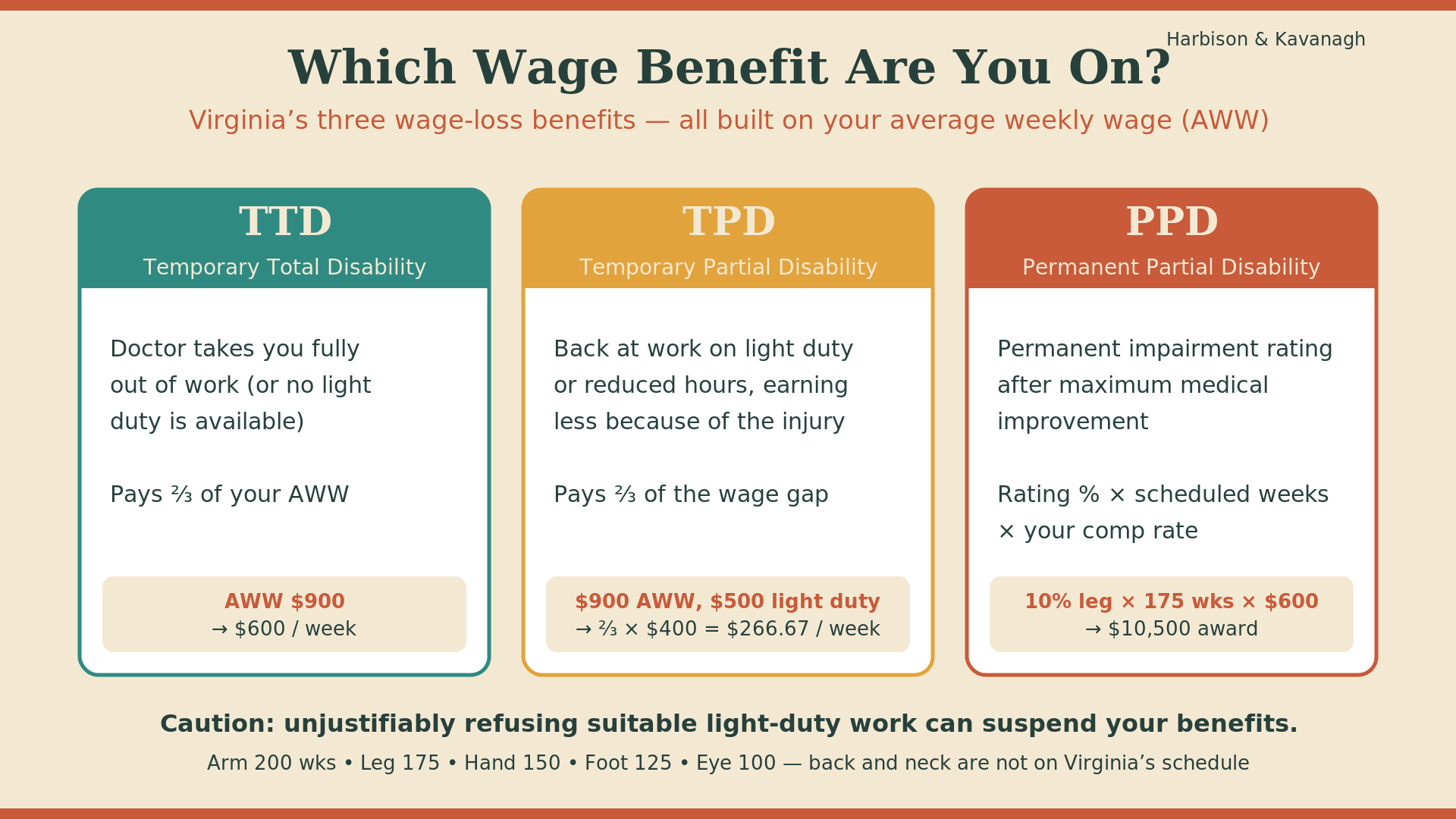
Temporary Total Disability (TTD) is the full two-thirds benefit, paid when your authorized treating physician takes you completely out of work, or your employer cannot accommodate your restrictions.
Temporary Partial Disability (TPD) applies when you are back at work but earning less because of the injury – light duty, reduced hours, or a lower-paying role. TPD pays two-thirds of the difference between your pre-injury AWW and your current earnings.
An example makes it concrete. Maria’s AWW was $900. Her doctor releases her to light duty, and her employer offers a desk assignment paying $500 a week. Her TPD check is two-thirds of the $400 difference – $266.67 a week on top of her light-duty wages.
One warning belongs in bold for every injured worker: if you unjustifiably refuse selective employment that fits your restrictions, your benefits can be suspended. Light-duty offers, and how you respond to them, are where many Virginia claims go sideways.
Which Wage Benefit Are You On? TTD vs. TPD vs. PPD
HOW ARE PERMANENT INJURIES PAID?
When you reach maximum medical improvement and a doctor assigns a permanent impairment rating to an injured body part, Virginia pays Permanent Partial Disability (PPD) using a schedule of weeks set by statute.
Each body part is assigned a maximum number of weeks – for example, 200 weeks for an arm, 175 for a leg, 150 for a hand, 125 for a foot, and 100 for the vision of one eye. Your award is your impairment percentage multiplied by the scheduled weeks, paid at your two-thirds compensation rate.
A 10 percent permanent impairment to a leg, for a worker with a $600 weekly compensation rate, is 10 percent of 175 weeks – 17.5 weeks – times $600: a $10,500 award. Importantly, Virginia’s schedule covers extremities, vision, and hearing – but not the back, neck, or body as a whole, which is one of several reasons back-injury cases need careful strategy.
Permanent Total Disability (PTD) is reserved for the most catastrophic losses – both hands, arms, feet, legs, eyes, or any two in the same accident, or certain severe brain injuries and paralysis. PTD can pay wage benefits for life, beyond the usual 500-week limit.
HOW LONG DO WORKERS’ COMP BENEFITS LAST IN VIRGINIA?
The general ceiling on wage benefits is 500 weeks – about nine and a half years – combining TTD and TPD. PPD weeks come out of the same 500-week pool. Only permanent total disability extends past it.
Medical benefits run on a different track: for life, for treatment causally related to the injury, as long as an award order is in place. A 2026 knee injury can still be insurer-paid surgery in 2046 if the award and causation hold.
That is why the long-game answer to how much does workers comp pay in Virginia is bigger than the weekly check – the lifetime medical award is frequently the most valuable benefit in the entire case, and it is also the one most often bargained away in settlement without a full understanding of its worth.
WHAT DOES WORKERS’ COMP COVER BEYOND THE WEEKLY CHECK?
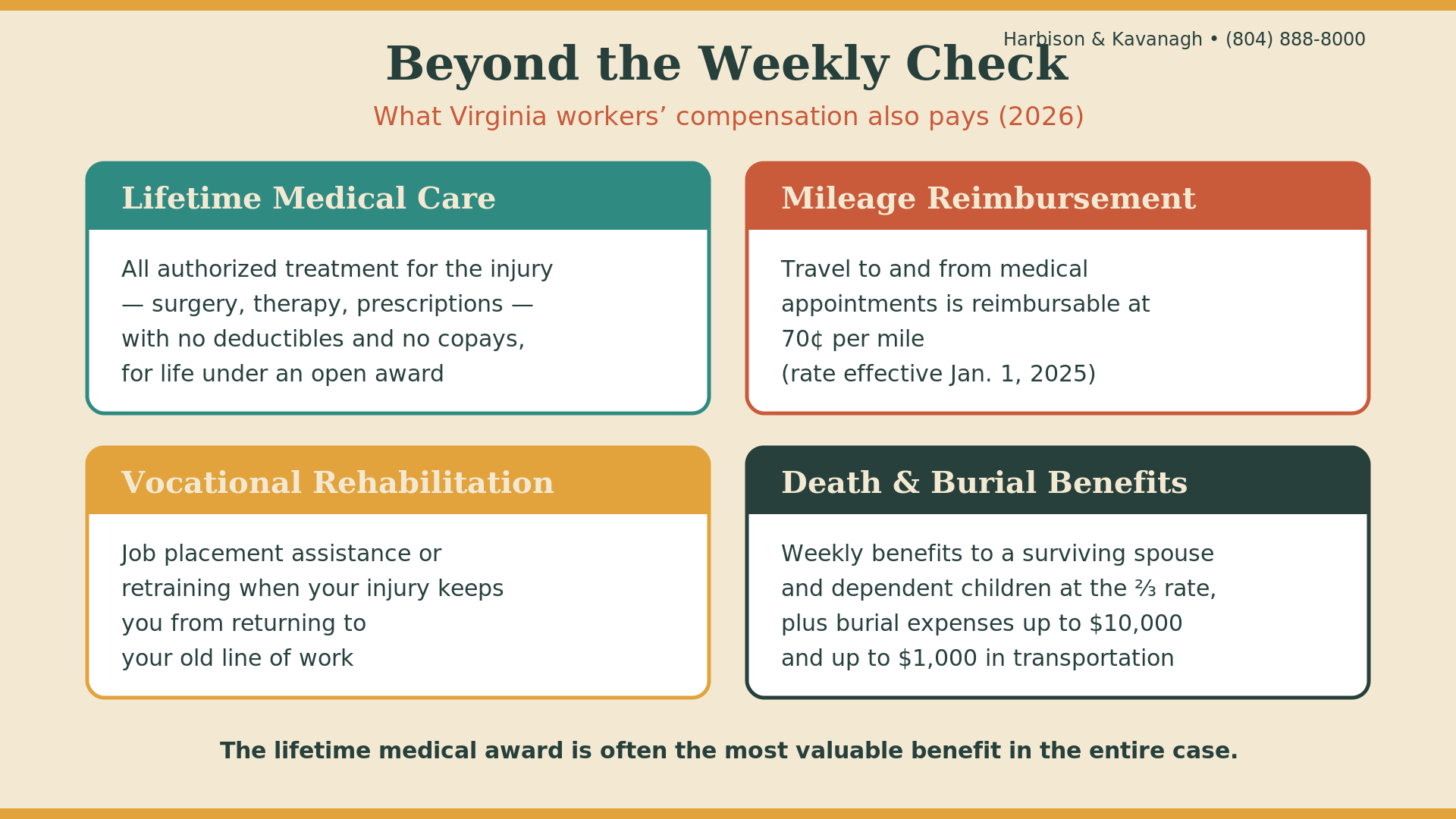
All authorized medical treatment for the work injury is covered at no cost to you – no deductibles, no copays – including surgery, therapy, prescriptions, and prosthetics.
Mileage to and from medical appointments is reimbursable, currently at 70 cents per mile (the rate effective January 1, 2025).
Vocational rehabilitation – job placement help or retraining – may be provided when you cannot return to your old work.
Death benefits support dependents when a work injury is fatal: weekly benefits to a surviving spouse and dependent children at the same two-thirds rate, plus burial expenses up to $10,000 and up to $1,000 in transportation expenses.
Beyond the Weekly Check: What Virginia Workers’ Comp Also Pays
AN ATTORNEY’S POINT OF VIEW: THE WAGE NUMBER EVERYONE GETS WRONG
After years of handling Virginia workers’ compensation cases, the most common – and most expensive – error we see is a quiet one: an average weekly wage that is simply too low.
Consider a (hypothetical) claimant we will call “Dale,” a 44-year-old HVAC technician in Chesterfield County. His base pay was $22 an hour, and the insurer’s wage chart dutifully showed an AWW of $880 – a $586.67 weekly check. But Dale had averaged six hours of overtime every week for the past year, and he ran weekend service calls for a second company doing the same trade.
Counting the overtime and the similar second employment, his true AWW was over $1,150 – a compensation rate of about $767. That difference of $180 a week, projected across a long disability and a PPD award calculated at the same rate, was worth tens of thousands of dollars. Nothing about his injury changed; only the arithmetic did. (This illustration is for education only; outcomes vary by case.)
The lesson: before you accept any award agreement, make sure the wage number under it is right. Every future dollar in the case is built on it.
WATCH AND LEARN
Prefer to watch instead of read? Our companion video walks through how much workers’ comp pays in Virginia – the two-thirds rule, the 2026 maximum and minimum rates, the seven-day waiting period, and how permanent injury awards are calculated.
How Much Does Workers’ Comp Pay in Virginia? (Harbison & Kavanagh)
For a broader map of everything the system provides, see our related guide: Virginia Workers’ Compensation Benefits: 7 Essential Entitlements
FREQUENTLY ASKED QUESTIONS
Q: How much does workers comp pay in Virginia per week?
Two-thirds of your gross average weekly wage, between the state minimum of $365.78 and maximum of $1,463.10 for injuries on or after July 1, 2025. The benefit is tax-free.
Q: Is overtime included in my workers’ comp pay calculation?
Yes. The average weekly wage is based on your actual gross earnings over the 52 weeks before the injury, including overtime – not just your base rate.
Q: Why is there no money for my first week off work?
Virginia imposes a seven-day waiting period. If your disability lasts more than three weeks, the insurer must retroactively pay that first week.
Q: Does workers’ comp in Virginia pay for pain and suffering?
No. Workers’ compensation is a no-fault system limited to wage benefits, medical care, and related allowances. Pain and suffering is not a recoverable category, which is a key difference from a personal injury lawsuit.
Q: Can my weekly check be reduced if I go back to work light duty?
It changes rather than disappears: you move from total disability to partial disability and receive two-thirds of the gap between your old wages and your light-duty earnings. Refusing suitable light duty without justification, however, can suspend benefits.
Q: How long can I receive workers’ comp checks in Virginia?
Generally up to 500 weeks of combined wage benefits. Permanent total disability cases can be paid for life, and medical benefits for the injury are lifetime under an open award.
TALK TO A VIRGINIA WORKERS’ COMPENSATION ATTORNEY
At Harbison & Kavanagh, we are dedicated to helping you navigate the workers’ compensation process. If you have been injured on the job and want to make sure every benefit is calculated correctly, call us today at (804) 888-8000, or visit our contact page to schedule a free consultation. Our experienced lawyers are here to provide the support and guidance you need.
Related Posts